Introduction
A Simple Habit That Can Transform Your Health
When people think about improving their health, they often imagine intense workouts, expensive equipment, or complicated fitness programs. Yet one of the most powerful forms of exercise is also one of the simplest: walking.
Walking requires no special skills, can be done almost anywhere, and is accessible to people of all ages and fitness levels. More importantly, a daily walking habit can provide significant benefits for your body, mind, and overall well-being. (Ding et al., 2025)
Why Walking Matters
Our bodies were designed to move. Regular movement helps support healthy circulation, maintain muscle strength, improve balance, and promote long-term vitality. (Health Benefits of Physical Activity for Adults, 2026)
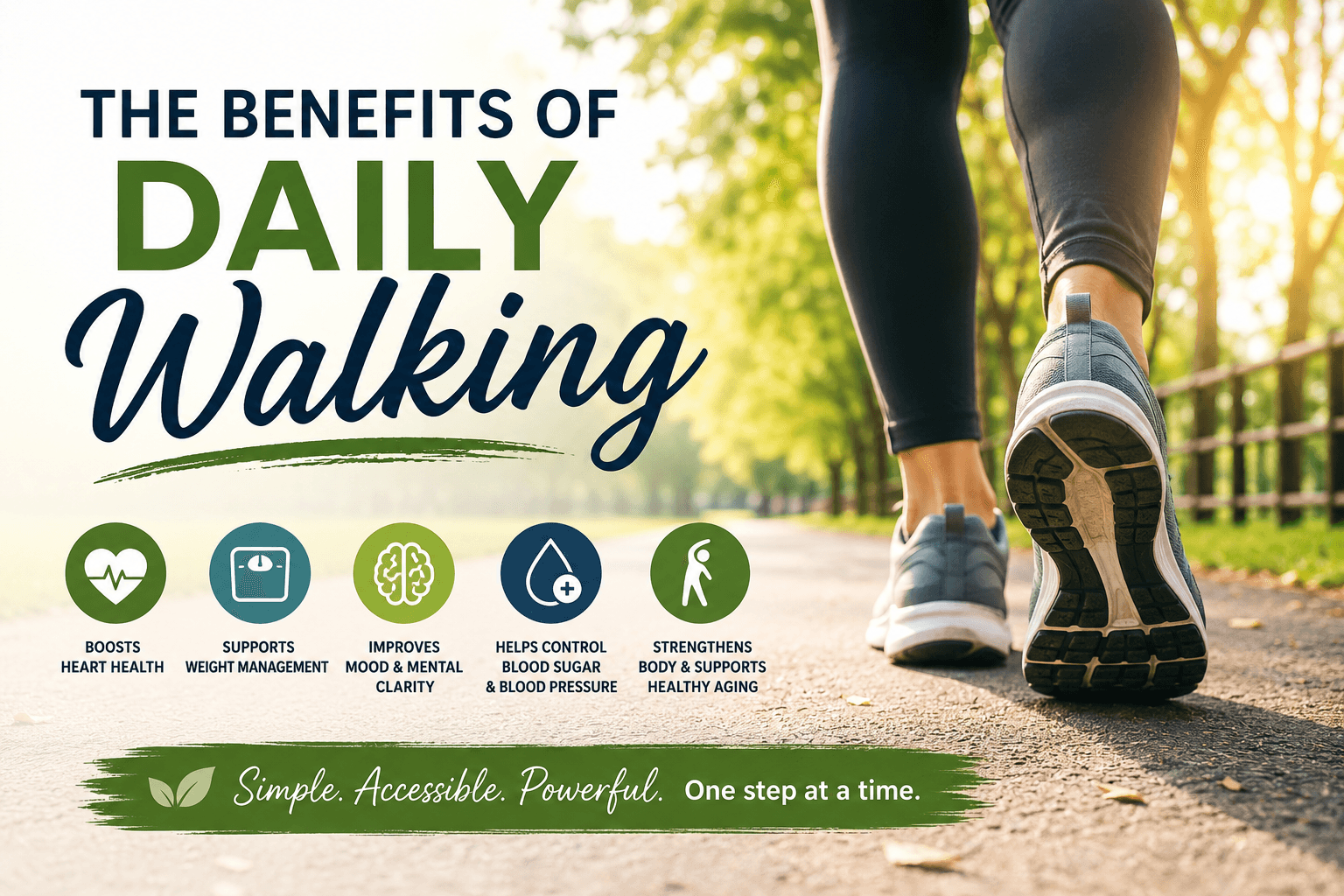
Walking is a gentle form of exercise that can help:
- Improve cardiovascular health
- Support healthy weight management.
- Lower blood pressure
- Improve blood sugar control.
- Strengthen muscles and joints.
- Increase energy levels
- Support healthy aging (Murphy et al., 2007, pp. 377-385)
Even a modest amount of daily walking can contribute to better overall health. (Xu et al., 2024
Benefits for Your Mind
The benefits of walking extend beyond physical health.
A daily walk can help:
- Reduce stress and tension.
- Improve mood
- Increase mental clarity
- Support emotional well-being
- Encourage mindfulness and reflection. (MD, 2023)
Many people find that walking provides an opportunity to slow down, think clearly, and reconnect with themselves. (Mindful Walking: Stay Grounded by Walking Mindfully, 2018)
Small Steps Add Up
One of the greatest advantages of walking is that it does not require perfection.
You do not need to walk ten miles a day.
You do not need special athletic ability.
You simply need to begin.
A ten-minute walk today can become a fifteen-minute walk next week. Over time, these small steps add up to meaningful improvements in health and fitness. (Ding et al., 2024)
How to Start
If you're new to regular movement, start small.
Try:
- A 10-minute walk after meals
- A short morning walk around your neighborhood.
- Walking while listening to a podcast or audiobook
- Parking farther away and walking more during daily activities
- Taking walking breaks during the day
The goal is consistency, not intensity.
Walking and Lifelong Wellness
Daily walking is one of the simplest ways to support the goals of the Move with Purpose pillar. It also connects to Nourish Your Body, Master Your Mindset, Hidden Forces, and Live With Intention by encouraging regular movement, supporting physical and mental health, and helping build habits that can last a lifetime. (Staff, 2024)
The journey to better health does not begin with a marathon.
Often, it begins with a single step.
Conclusion
Walking may seem simple, but its impact can be lasting. By taking small, consistent steps, you can support your body, mind, and overall well-being.
Author's Note
Walking has remained an important part of my own health journey. While I have enjoyed running marathons and participating in long-distance cycling events, I have learned that lasting health is built through consistent daily habits. Walking is one of the easiest and most effective ways to begin. Start where you are, move at your own pace, and let each step bring you closer to better health.
— Robert
Continue The Conversation
Every wellness journey is unique, and we can learn a great deal from one another's experiences.
What stood out to you in this article?
Have you faced similar challenges, discovered helpful strategies, or gained insights of your own?
I invite you to share your thoughts in the comments below. Your experience may encourage someone else who is taking the next step on their own journey.
Remember, meaningful change often begins with a single step—and none of us has to walk the path alone.
Resource List
Ding, D., Nguyen, B., Nau, T., Luo, M., Cruz, B. D., Dempsey, P. C., Munn, Z., Jefferis, B. J., Sherrington, C., Calleja, E. A., Chong, K. H., Davis, R., Francois, M. E., Tiedemann, A., Biddle, S. J., Okely, A., Bauman, A., Ekelund, U., Clare, P. & Owen, K. (2025). Daily steps and health outcomes in adults: a systematic review and dose-response meta-analysis. The Lancet Public Health 10(8). https://doi.org/10.1016/S2468-2667(25)00164-1
(2026). Health Benefits of Physical Activity for Adults. Centers for Disease Control and Prevention. https://www.cdc.gov/physical-activity-basics/health-benefits/adults.html
Murphy, M. H., Nevill, A. M., Murtagh, E. M. & Holder, R. L. (2007). The effect of walking on fitness, fatness, and resting blood pressure: A meta-analysis of randomized, controlled trials. Preventive Medicine 44(5), pp. 377-385. https://doi.org/10.1016/j.ypmed.2006.12.008
Xu, C., Jia, J., Zhao, B., Yuan, M., Luo, N., Zhang, F., & Wang, H. (2024). Objectively measured daily steps and health outcomes: an umbrella review of the systematic review and meta-analysis of observational studies. BMJ Open 14(10). https://doi.org/10.1136/bmjopen-2024-088524
(2018). Mindful Walking: Stay Grounded by Walking Mindfully. Mindfulness.com. https://mindfulness.com/mindful-living/mindful-walking
MD, T. S. (2023). The Health Benefits of Walking. Cleveland Clinic. https://health.clevelandclinic.org/benefits-of-walking/
Ding, D., Nguyen, B., Nau, T., Luo, M., Cruz, B. D., Dempsey, P. C., Munn, Z., Jefferis, B. J., Sherrington, C., Calleja, E. A., Chong, K. H., Davis, R., Francois, M. E., Tiedemann, A., Biddle, S. J., Okely, A., Bauman, A., Ekelund, U., Clare, P. & Owen, K. (2024). Objectively Measured Daily Steps and Health Outcomes: An Umbrella Review of Systematic Reviews and Meta-Analyses of Observational Studies. BMJ Open 14(10). https://doi.org/10.1136/bmjopen-2024-088524
Staff, M. C. (2024). Walking: Trim your waistline, improve your health. Mayo Clinic. https://www.mayoclinic.org/health/walking/HQ01612
Hanson, S. & Jones, A. (2015). Is there evidence that walking groups have health benefits? A systematic review and meta-analysis. British Journal of Sports Medicine 49(11), pp. 710-717. https://doi.org/10.1136/bjsports-2014-094157
Disclaimer
The information provided in this article is for educational and informational purposes only and is not intended as medical, psychological, or professional advice. The content reflects general wellness principles and personal development concepts designed to encourage self-reflection and healthy lifestyle choices.
Individual circumstances vary, and readers should consult qualified healthcare professionals, mental health providers, or other appropriate experts regarding specific concerns or conditions. Never disregard professional advice or delay seeking help because of information contained in this article.
The author and publisher assume no responsibility for actions taken based on the information presented. Your health and well-being are ultimately your responsibility, and any changes to your lifestyle should be made thoughtfully and in consultation with appropriate professionals when necessary.