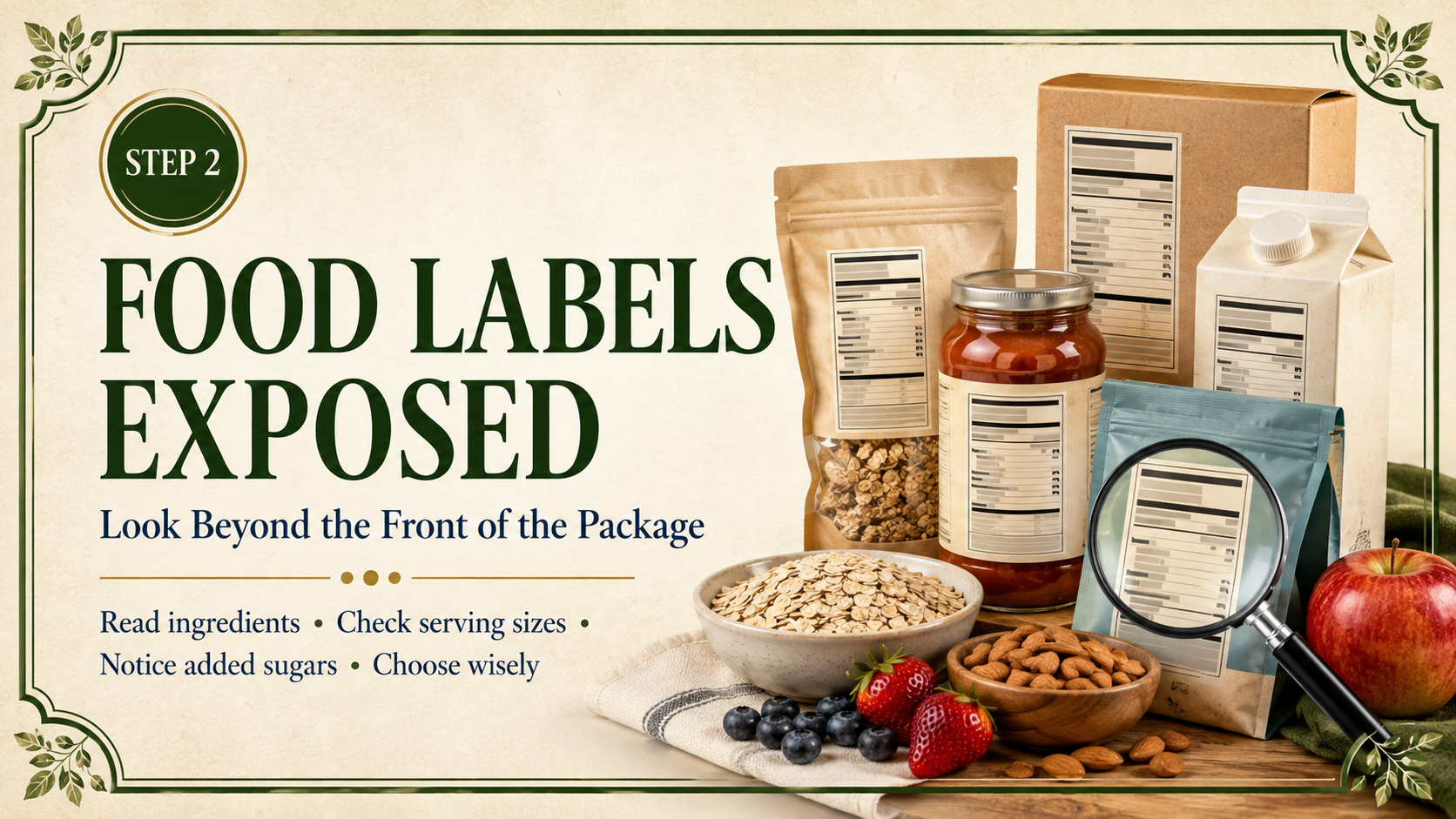
Introduction: Food Labels Exposed
Food labels are crafted to sell products, not necessarily to clarify healthy choices. Understanding their real intent transforms how you judge packaged foods.
For those who know me, I follow a whole-food, plant-strong lifestyle. I have completed a three-course certification in Plant-Based Nutrition through eCornell. One of the most revealing lessons was this: you don’t need to be a scientist to read food labels—you just need to recognize what the food industry prefers to keep hidden.
This guide not only reveals common labeling tactics but also equips you with practical tools to navigate food packaging with confidence. To set the stage, let’s start by exploring why food labels can be so misleading in the first place.
Why Food Labels Are So Misleading
Words like natural, fat‑free, heart‑healthy, light, or no added sugar are often meaningless. They create a feeling, not tell the truth.
With these insights in mind, let’s dive deeper into real-life examples of label deception that further illustrate just how confusing packaging can be.
The Industry Trick That Shocked Me
During my eCornell training, we analyzed a label that looked almost too good to be true: Pam cooking spray.
The label claimed:
- 0 calories
- 0 fat
- 0 everything
But the ingredients list canola oil, which is 100% fat.
So how can a pure fat product legally claim to be fat‑free?
Here’s the trick:
If a serving size is under 0.5 grams, companies can round it down to zero. (Guidance for Industry: Serving Sizes of Foods That Can Reasonably Be Consumed At One Eating Occasion, Reference Amounts Customarily Consumed, Serving Size-Related Issues, Dual-Column Labeling, and Miscellaneous Topics, 2019)
Pam’s serving size?
One‑third of a second spray.
That isn’t a realistic serving size—it’s a way to sidestep transparency.
And it doesn’t stop there:
- “I Can’t Believe It’s Not Butter” spray.
- “Fat‑Free” olive oil sprays
- “Naturally Fat‑Free” cooking oils
All use the same trick.
Once you catch this tactic, it becomes clear just how labels mislead consumers.
Jeff Novick is an expert on Reading Food Labels
Building on his lessons, here are Jeff Novick’s rules for reading nutrition facts that help cut through industry tricks and create clarity in the labels we see every day.
Jeff Novick’s Simple Rules for Reading Nutrition Facts
Jeff Novick’s approach cuts through confusion and gives you a 10‑second system to evaluate any packaged food.
Rule #1 — Never believe anything on the front.
If it’s printed on the front, assume it’s marketing.
Rule #2 — Go straight to the Nutrition Facts and ingredients.
Here’s what to look for:
Fat:
No more than 20% of calories should come from fat.
Sodium:
Sodium should never exceed calories.
Example:
150 calories → sodium should be 150 mg or less
Ingredients:
Look for three things:
- Whole grains
- No bad fats
- Minimal added sugars
If a product passes these tests, you’ve found one of the better packaged options. (Nutrition, Food Labeling, and Critical Foods, 2024) Now, let’s put this quick test into practice during a typical grocery trip.
The 10‑Second Label Test
Use this every time you pick up a package:
- Ignore the front.
- Flip it over.
- Check fat % (≤20%).
- Check sodium (≤ calories).
- Scan ingredients for whole foods.
- Put it back if it fails any test.
This simple system saves time, protects your health, and supports a whole-food, plant-strong lifestyle. With these steps integrated, let's conclude with a few final thoughts on what this process means for your shopping habits.
Final Thoughts on Reading Labels
Food labels are designed to persuade, not to provide clear information. By spotting their tricks, you stay in control and avoid marketing traps.
Your health is too important to leave to food companies.
These principles alone will put you ahead of most shoppers: (Labeling, 2003)
1. Fresh fruits, vegetables, beans, and whole grains — these foods speak for themselves.
2. Never trust the front of the package.
If it’s shouting health claims, it’s usually hiding something. (Mayer et al., 1998, pp. 189-195)
3. Read the ingredient list first.
Look for whole grains, recognizable ingredients, and as few additives as possible.
4. Scan the Nutrition Facts for the big three:
- Bad fats
- Sodium
- Added sugars
Mastering Jeff Novick’s simple system gives you an edge over marketing tricks and helps you see past food-label deception.
Author’s Note
Learning to dissect food labels changed how I approach healthy choices. I created this resource to expose how marketing disguises unhealthy products, giving you tools to make genuinely informed decisions. Let’s keep focusing on health, not packaging.
---- Robert
Continue The Conversation
Every wellness journey is unique, and we can learn a great deal from one another's experiences.
What stood out to you in this article?
Have you faced similar challenges, discovered helpful strategies, or gained insights of your own?
I invite you to share your thoughts in the comments below. Your experience may encourage someone else who is taking the next step on their own journey.
Remember, meaningful change often begins with a single step—and none of us has to walk the path alone.
Reference List
(2019). Guidance for Industry: Serving Sizes of Foods That Can Reasonably Be Consumed At One Eating Occasion, Reference Amounts Customarily Consumed, Serving Size-Related Issues, Dual-Column Labeling, and Miscellaneous Topics. FDA. https://www.fda.gov/regulatory-information/search-fda-guidance-documents/guidance-industry-serving-sizes-foods-can-reasonably-be-consumed-one-eating-occasion-reference
(2024). Nutrition, Food Labeling, and Critical Foods. FDA. https://www.fda.gov/food/food-labeling-nutrition
(n.d.). Consumer Research on Labeling, Nutrition, Diet, and Health. FDA. https://www.fda.gov/food/social-and-behavioral-science-research-food/consumer-research-labeling-nutrition-diet-and-health
Labeling, I. o. (2003). Guiding Principles for Selecting Reference Values for Nutrition Labeling. National Academies Press. https://www.ncbi.nlm.nih.gov/books/NBK208887/
Mayer, J. A., Maciel, T. L., Orlaski, P. L. & Flynn-Polan, G. (1998). Misleading Nutrition Claims on Cracker Packages Prior to and Following Implementation of the Nutrition Labeling and Education Act of 1990. American Journal of Preventive Medicine 14(3), pp. 189-195. https://doi.org/10.1016/S0749-3797(97)00060-3
Disclaimer
The information provided in this article is for educational and informational purposes only and is not intended as medical, psychological, or professional advice. The content reflects general wellness principles and personal development concepts designed to encourage self-reflection and healthy lifestyle choices.
Individual circumstances vary, and readers should consult qualified healthcare professionals, mental health providers, or other appropriate experts regarding specific concerns or conditions. Never disregard professional advice or delay seeking help because of information contained in this article.
The author and publisher assume no responsibility for actions taken based on the information presented. Your health and well-being are ultimately your responsibility, and any changes to your lifestyle should be made thoughtfully and in consultation with appropriate professionals when necessary.