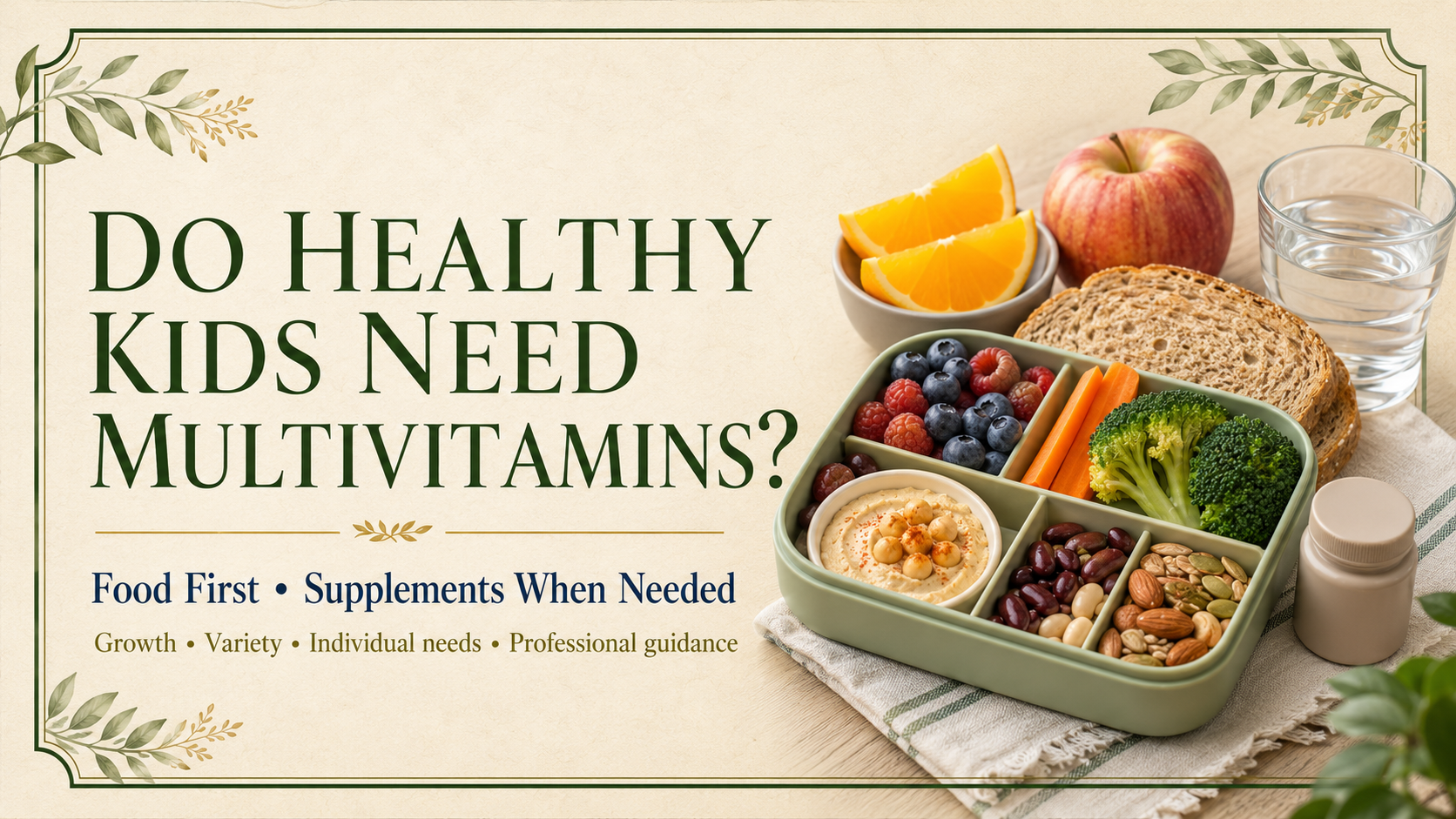
Introduction: Do Healthy Kids Need Multivitamins?
Parents want the best for their kids — strong bodies, sharp minds, and lifelong healthy habits. Multivitamins are a booming industry. But do healthy kids really need them?
Before diving in, let’s break down the facts in a way that makes sense for real families.
Kids Absolutely Need Vitamins — But Food Should Come First
Healthy kids require essential nutrients like vitamins, minerals, proteins, natural sugars, complex carbohydrates, and fiber from colorful, whole foods.
Gummies or chewable can’t replace a varied, balanced diet.
A multivitamin can’t compete with:
- A bowl of steel‑cut oats topped with berries
- A plate of roasted vegetables
- A hearty bean-and-rice bowl
- A handful of nuts or fresh fruit
Whole foods deliver vitamins along with fiber, antioxidants, water, and plant compounds that supplements can’t match.
Why Food Beats Supplements Every Time
Fresh, whole foods deliver a rich mix of nutrients in the best balance.
- The highest concentration of vitamins and minerals
- Nutrients delivered in the right balance
- Natural “buffering” that prevents excessive intake
- Better digestion, better energy, and better long-term habits
Fast food and convenience snacks can’t be undone by a daily gummy. And more food isn’t the answer either — more variety is.
Small, kid-sized portions of a variety of fruits, vegetables, grains, and legumes throughout the day help children meet their nutritional needs without overeating.
And if your child goes on a “food strike” for a few days? That’s normal. Reintroduce foods gently, prepared in new ways. Kids usually come around on their own.
With that in mind, let’s address another common question: Are multivitamins being overused?
It’s easy to think every child needs a multivitamin — especially when marketing is aimed directly at parents who want to do the right thing.
But here’s the truth:
- Nearly half of U.S. 3‑year‑olds take a multivitamin at least occasionally. (Stierman et al., 2026)
- Yet research on benefits is surprisingly limited. (MD, 2026)
- Formulas vary wildly from brand to brand.
- Some contain iron, some don’t
- Some include only a few vitamins, others include dozens.
Because all these products are lumped together as “multivitamins,” it’s difficult for researchers to determine which combinations are helpful, neutral, or potentially unnecessary. (Dwyer et al., 2022, pp. 525-532)
Nutrients in pills are more concentrated, so more isn’t always better—especially for growing kids. (Frisbie et al., 2026)
When Supplements May Make Sense
There are situations where a supplement can be helpful. For example:
- Limited sun exposure (Vitamin D)
- Strict plant-based diets (Vitamin B12)
- Iron deficiency or low iron intake
- Extremely selective eating
- Multiple food avoidances
In these situations, a single-nutrient supplement—targeted to the specific need—may be more beneficial and appropriate than a general multivitamin. (Kurpad et al., 2013, pp. 328-338)
The best approach is simple:
Discuss your child’s individual circumstances with their pediatrician to decide if a supplement is appropriate. The best approach is a personalized plan, rather than relying on a general multivitamin as a catch-all solution.
Final Thoughts
Multivitamins may help in some cases, but healthy kids don’t need them for daily nutrition. Focus on whole foods, active play, good sleep, and a supportive environment. Use supplements only when necessary to fill true gaps. With patience and awareness, you can help your child build healthy habits for life.
Author's note
As a parent and educator, I’ve seen firsthand how confusing children’s nutrition can feel. We all want to give our kids every advantage, and the supplement aisle can make it seem like a daily multivitamin is the safest path. My goal with this article is to bring clarity and calm to that decision. Kids’ nutritional needs are real, but they’re also wonderfully simple when we focus on whole foods, balanced meals, and habits that grow with them. Supplements can play a role, but they’re never a substitute for the nourishment that comes from real food and shared family routines.
--- Robert
Special Note to Parents
Most healthy kids get the vitamins they need from varied diets, even with picky eating or repeated favorites. (Kemp, 2022) When used, supplements like vitamin D or B12 should be seen as supportive tools, not a source of pressure.
A few simple habits make the biggest difference:
- Offer colorful foods often, without forcing.
- Keep mealtimes relaxed and predictable.
- Model the choices you hope they’ll grow into.
- Ask your child’s healthcare provider when you’re unsure—every child is unique.
Your encouragement matters more than any multivitamin.
Continue The Conservation
Every wellness journey is unique, and we can learn a great deal from one another's experiences.
What stood out to you in this article?
Have you faced similar challenges, discovered helpful strategies, or gained insights of your own?
I invite you to share your thoughts in the comments below. Your experience may encourage someone else who is taking the next step on their own journey.
Remember, meaningful change often begins with a single step—and none of us has to walk the path alone.
Reference List
- American Academy of Pediatrics. Vitamin and Mineral Supplements: What Parents Should Know.
- National Institutes of Health, Office of Dietary Supplements. Vitamin D Fact Sheet for Consumers. Updated 2024.
- National Institutes of Health, Office of Dietary Supplements. Vitamin B12 Fact Sheet for Consumers. Updated 2024.
- Academy of Nutrition and Dietetics. Kids and Vitamins: Do They Need Them?
- Harvard T.H. Chan School of Public Health. The Nutrition Source: Children’s Nutrition.
- Centers for Disease Control and Prevention. Micronutrient Facts.
- U.S. Department of Agriculture. FoodData Central.
Stierman, B., Couch, C. A., Gahche, J. J., & Mishra, S. (May 21, 2026). Dietary Supplement Use: United States, August 2021–August 2023. NCHS Data Brief No. 561. https://www.cdc.gov/nchs/products/databriefs/db561.htm
MD, M. M. (April 12, 2026). Do multivitamins make you healthier?. Harvard Health. https://www.health.harvard.edu/preventive-care/do-multivitamins-make-you-healthier
Dwyer, J. T., Saldanha, L. G., & Bailen, R. A. (2022). Do Multivitamin/Mineral Dietary Supplements for Young Children Fill Critical Nutrient Gaps?. Journal of the Academy of Nutrition and Dietetics 122(3), pp. 525-532. https://doi.org/10.1016/j.jand.2021.10.019
Frisbie, S. H., Mitchell, E. J., Hoeltge, A., Pett, L. A., & Hoeltge, M. G. (2026). Excessive manganese content in children's multivitamin supplements: Potential for neurodevelopmental harm and other adverse health outcomes. PLoS One 21(3). https://doi.org/10.1371/journal.pone.0343600
Kurpad, A. V., Edward, B. S. & Aeberli, I. (2013). Micronutrient supplementation in children: a review of the evidence. Current Opinion in Clinical Nutrition and Metabolic Care 16(3), pp. 328-338. https://doi.org/10.1097/MCO.0b013e32835e8d0b
Kemp, C. (January 1, 2022). Many multivitamins do not match nutritional needs. AAP News. https://publications.aap.org/aapnews/news/18890/Many-multivitamins-do-not-match-nutritional-needs
Disclaimer
The information provided in this article is for educational and informational purposes only and is not intended as medical, psychological, or professional advice. The content reflects general wellness principles and personal development concepts designed to encourage self-reflection and healthy lifestyle choices.
Individual circumstances vary, and readers should consult qualified healthcare professionals, mental health providers, or other appropriate experts regarding specific concerns or conditions. Never disregard professional advice or delay seeking help because of information contained in this article.
The author and publisher assume no responsibility for actions taken based on the information presented. Your health and well-being are ultimately your responsibility, and any changes to your lifestyle should be made thoughtfully and in consultation with appropriate professionals when necessary.