How Your Thoughts Shape Your Health
Your mindset shapes every choice, habit, and challenge you encounter. When you identify and shift unhelpful mental patterns, you unlock greater freedom and transform your health. This is the Mindset pillar—the foundation of your entire wellness journey.
Why You Feel Stuck (Even When You’re Trying Your Best)
Most people think their habits are the problem — not enough willpower, not enough discipline, not enough motivation.
But the truth is simpler and far more powerful:
Your thoughts and beliefs quietly shape every choice you make. (Quinton & Crescioni, 2026)
They influence:
- What you reach for when you’re stressed
- How you respond to setbacks
- Whether you trust yourself to change
- How you interpret challenges, cravings, and emotions
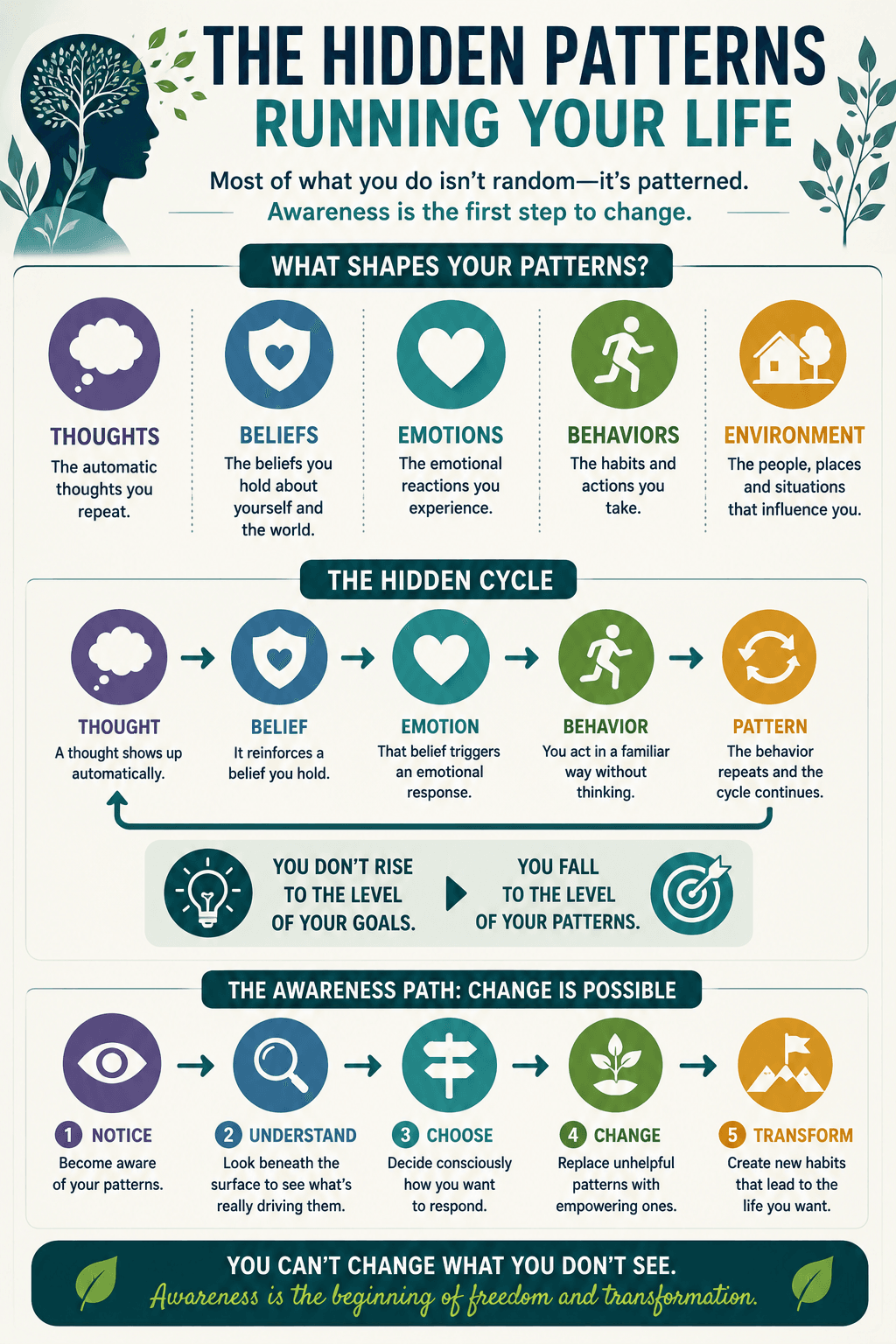
These patterns run in the background like an operating system.
And unless you learn to see them, they keep steering your life without your permission. (Conner et al., 2019)
The Autopilot Patterns You Don’t Realize You’re Following
Every one of us carries mental scripts formed by past experiences, family messages, stress, and old survival strategies. (Elias & Brown, 2022)
Some of the most common include:
- “I always mess this up.”
- “I don’t have time to take care of myself.”
- “Healthy people are just more disciplined than I am.”
- “If I can’t do it perfectly, why bother?”
These thoughts seem true, but they’re patterns—not realities.
They’re habits of mind.
And like any habit, they can be rewritten. (Growth Mindsets and Psychological Distress: A Meta-Analysis, 2020)
Why These Patterns Matter for Your Health
When your inner world is cluttered with stress, fear, or old beliefs, simple goals feel heavy.
But when your mindset becomes clearer and more supportive, everything else becomes easier: nutrition, movement, sleep, relationships, and daily habits. (Schreiber & Schotanus-Dijkstra, 2024)
This aligns directly with the purpose of your Mindset pillar: helping people build clarity, resilience, and emotional strength from the inside out.
Mindset is the underlying base supporting every other pillar of wellness.
A Simple First Step: Notice One Pattern Today
You don’t need to overhaul your entire inner world.
Start with awareness.
Today, simply notice one recurring thought that shows up when you’re stressed, tired, or trying to make a healthy choice.
Ask yourself:
- Is this thought actually true?
- Is it helpful?
- Is there a kinder, more accurate version I could practice instead?
This small shift, noticing instead of reacting, is the beginning of real change. (Remskar et al., 2024, pp. 1031-1048)
The Freedom That Comes from Seeing Clearly
When you understand your thoughts and regulate your emotions, you unlock a level of freedom that transforms your health and life. (Schreiber & Schotanus-Dijkstra, 2024)
Your mindset is not fixed.
It’s a living, evolving part of you — and you have the power to reshape it one intentional moment at a time. (Growth mindsets and psychological distress: A meta-analysis, 2020)
Conclusion
When you begin to notice the thoughts that shape your choices, you reclaim something powerful: the ability to respond instead of react. These hidden patterns aren’t flaws or failures—they’re simply old strategies your mind learned along the way. (Growth Mindsets and Psychological Distress: A Meta-Analysis, 2020) And once you can see them clearly, you can choose new ones that support your health, your confidence, and the life you want to build.
Change begins with awareness. One thought. One pause. One moment. These small shifts build a mindset that strengthens habits, resilience, and well-being. Start by noticing—progress gets lighter from there.
Author Notes
Throughout my years as an educator, I have learned that meaningful change rarely happens all at once. More often, it begins with awareness, understanding, and a willingness to take the next small step forward.
The ideas shared in this article are intended to encourage reflection and personal growth. My hope is that they help you better understand yourself and provide practical insights you can apply to your own life and wellness journey.
Remember, lasting change is not about perfection. It is about learning, growing, and making choices that move you closer to the life you want to create.
---- Robert
Continue the Conversation
Every wellness journey is unique, and we can learn a great deal from one another's experiences.
What stood out to you in this article?
Have you faced similar challenges, discovered helpful strategies, or gained insights of your own?
I invite you to share your thoughts in the comments below. Your experience may encourage someone else who is taking the next step on their own journey.
If you would like to receive future wellness insights, practical tips, and updates from Revolutionize Your Health, you are also welcome to join our community and stay connected.
Remember, meaningful change often begins with a single step—and none of us has to walk the path alone.
References
Tsujimoto, M., Saito, T., Matsuzaki, Y. & Kawashima, R. (2024). Role of Positive and Negative Emotion Regulation in Well-being and Health: The Interplay between Positive and Negative Emotion Regulation Abilities is Linked to Mental and Physical Health. Journal of Happiness Studies 25. https://doi.org/10.1007/s10902-024-00714-1
(2021). Competing influences on healthy food choices: Mind setting versus contextual food cues. Appetite 166. https://doi.org/10.1016/j.appet.2021.105476
Quinton, T. S. & Crescioni, A. W. (2026). Free to be Healthy? Free Will Beliefs are Positively Associated with Health Behavior. Psychological Reports 129(2). https://doi.org/10.1177/00332941241260264
Conner, A. L., Boles, D. Z., Markus, H. R., Eberhardt, J. L., & Crum, A. J. (2019). Americans’ Health Mindsets: Content, Cultural Patterning, and Associations With Physical and Mental Health. Annals of Behavioral Medicine 53(4). https://doi.org/10.1093/abm/kay041
Elias, A. & Brown, A. D. (2022). The role of intergenerational family stories in mental health and well-being. Frontiers in Psychology 13. https://doi.org/10.3389/fpsyg.2022.927795
(2020). Growth Mindsets and Psychological Distress: A Meta-Analysis. Clinical Psychology Review 77. https://doi.org/10.1016/j.cpr.2020.101816
Schreiber, C. & Schotanus-Dijkstra, M. (2024). Enhancing mental well-being by changing mindsets? Results from two randomized controlled trials. BMC Psychology 12. https://doi.org/10.1186/s40359-023-01470-2
O’Brien, A. G., Foust, J. L., & Taber, J. M. (2024). Physical health, mindsets, and information avoidance. Journal of Behavioral Medicine 47. https://doi.org/10.1007/s10865-024-00514-1
Remskar, M., Western, M. J. & Ainsworth, B. (2024). Mindfulness improves psychological health and supports health behavior cognitions: Evidence from a pragmatic RCT of a digital mindfulness-based intervention. British Journal of Health Psychology 29(4), pp. 1031-1048. https://doi.org/10.1111/bjhp.12745
(2020). Growth mindsets and psychological distress: A meta-analysis. Clinical Psychology Review 77. https://doi.org/10.1016/j.cpr.2020.101816
Lin, L. C., Chan, M., Hendrickson, S. & Zuñiga, J. A. (2020). Resiliency and Self-Care Behaviors in Health Professional Schools. Journal of the Society of Pediatric Nurses 25(4), pp. 1-9. https://doi.org/10.1177/0898010120933487
Disclaimer
The information provided in this article is for educational and informational purposes only and is not intended as medical, psychological, or professional advice. The content reflects general wellness principles and personal development concepts designed to encourage self-reflection and healthy lifestyle choices.
Individual circumstances vary, and readers should consult qualified healthcare professionals, mental health providers, or other appropriate experts regarding specific concerns or conditions. Never disregard professional advice or delay seeking help because of information contained in this article.
The author and publisher assume no responsibility for actions taken based on the information presented. Your health and well-being are ultimately your responsibility, and any changes to your lifestyle should be made thoughtfully and in consultation with appropriate professionals when necessary.