Introduction
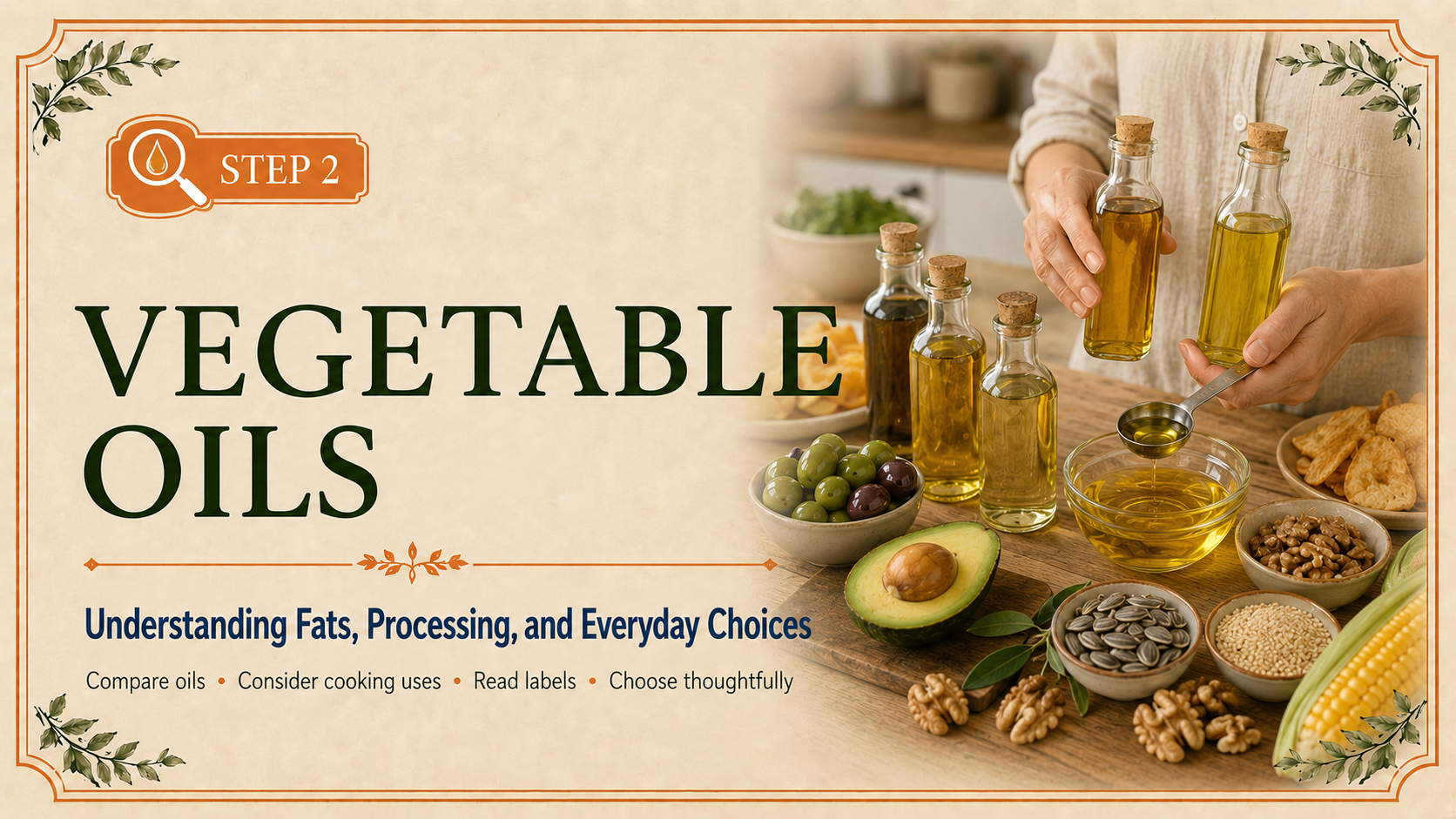
Vegetable oils are everywhere — in packaged foods, restaurant meals, and even recipes promoted as “healthy.” (Clapp et al., 2014) With so much conflicting information, it’s no surprise people feel confused. Are these oils harmless? Helpful? Harmful? Or simply misunderstood?
This updated guide cuts through the confusion to highlight the main argument: understanding the claims, science, and context around vegetable oils empowers you to support long-term health. The video you selected is a practical demonstration of this message. Let’s start by examining what most people typically hear about vegetable oils.
What Most People Hear About Vegetable Oils
Mainstream nutrition messaging often promotes vegetable oils as:
Heart‑healthy
Rich in “good fats”
Better than butter or animal fats
Essential for lowering cholesterol
And because they’re called vegetable oils, many assume they must be healthy by default.
But as you know, the truth is more nuanced.
What the Evidence Actually Shows
1. Not all vegetable oils are the same
Soybean, corn, canola, sunflower, safflower — each has a different fatty acid profile. Some are high in omega‑6 fats, which can contribute to inflammation when consumed in excess. Others are heavily refined, losing nutrients and forming unwanted compounds during processing.
2. Processing matters more than most people realize
3. The real problem is where these oils show up
Vegetable oils are a staple ingredient in ultra‑processed foods — the very foods linked to chronic inflammation, weight gain, and metabolic disease. As the Cleveland Clinic notes, the danger often lies in the context, not the oil alone.
4. “Healthy oil” messaging is often oversimplified
Media headlines and quick‑hit nutrition articles frequently repeat the same talking points without nuance. This leads to widespread misconceptions — especially the idea that “unsaturated = healthy,” no matter the source or amount.
Dr. Esselstyn argues that all oils are harmful to your health. To understand why, let’s consider his and other plant-based perspectives.
A Whole‑Food, Plant‑Based Perspective
From a plant‑based lens — especially the approach championed by Dr. Caldwell Esselstyn — the conclusion is straightforward:
Oils are highly processed and calorie-dense. As Dr. Esselstyn says, they offer no fiber, minimal nutrients, and no benefits compared to whole foods.
Your video reinforces this by showing why eliminating added oils can improve heart health, support weight management, and help prevent disease. So, what does all this mean for anyone wondering if vegetable oils are truly bad?
So… Are Vegetable Oils “Bad”?
he honest answer: It depends on the oil, the processing, the amount, and the overall diet.
If your goal is a whole‑food, plant‑based lifestyle focused on preventing or reversing chronic disease, the evidence most robustly supports minimizing or eliminating added oils. (Neuenschwander et al., 2023) This is the central argument: whole foods better promote health than extracted oils, regardless of popular claims.
Key takeaway: Whole foods provide better health benefits than extracted fats, supporting long-term well-being. If you’re interested in learning more about the science and practical applications, keep reading.
Want to Learn More?
Science confirms that a diet rich in whole, plant-based foods can help you live fully and still get adequate protein. (Evaluation of Protein Adequacy From Plant-Based Dietary Scenarios in Simulation Studies: A Narrative Review, 2024, pp. 300-313) A growing number of physicians advocate an entirely plant-based diet for many of their patients who suffer from diabetes, heart disease, and cancer. (Kalwaney & Cerceo, 2024)
Check out these great sources:
- Plant-Based Nutrition, 2E (Idiot’s Guides),
- Nutrition Facts: The Truth About Food
- The Forks Over Knives Plan
Final Thought
Key takeaway: Choosing whole plant foods for healthy fats avoids the calorie density, processing issues, and inflammatory compounds of refined oils, supporting a healthier lifestyle.
Confusion about vegetable oils arises from misleading messages. The core point is this: being labeled "vegetable" or "unsaturated" does not guarantee healthfulness. The most compelling science points to the importance of source, processing, and fatty acid profile—highly refined oils do not match the benefits of whole foods. (Tian et al., 2023)
Key takeaway: Focusing on whole plants, nuts, seeds, avocados, olives, and naturally occurring fats offers protective benefits for your heart, metabolism, and vitality—aligning your diet with long-term health. (Staff, 2026)
Author's Note
For decades, vegetable oils have been promoted as heart‑healthy staples—quietly woven into packaged foods, restaurant meals, and even many “healthy” recipes. Yet when we look closely at the science, the story becomes far more complex. My goal with this article is not to create fear or controversy, but to offer clarity in a space where marketing, headlines, and half‑truths often overshadow real evidence. As someone committed to whole‑food living, I believe we deserve honest conversations about what we put into our bodies and how those choices shape our long‑term health. I hope this guide helps you see beyond the slogans and empowers you to make decisions rooted in understanding, not assumptions.
---- Robert
Continue The Conversation
Every wellness journey is unique, and we can learn a great deal from one another's experiences.
What stood out to you in this article?
Have you faced similar challenges, discovered helpful strategies, or gained insights of your own?
I invite you to share your thoughts in the comments below. Your experience may encourage someone else who is taking the next step on their own journey.
Remember, meaningful change often begins with a single step—and none of us has to walk the path alone.
Reference List
Clapp, J., Curtis, C. J., Middleton, A. E., & Goldstein, G. P. (2014). Prevalence of Partially Hydrogenated Oils in US Packaged Foods, 2012. Preventing Chronic Disease 11. https://doi.org/10.5888/pcd11.140161
Mozaffarian, M. L., Micha, A. A., Cogswell, E. C., Karsonova, S. M., Lichtenstein, A. L., Appel, M. A., Loria, L. A. & Sacks, S. A. (2010). Dietary Fatty Acids and Cardiovascular Disease: A Review of the Evidence. Circulation 122(21), pp. 2527-2539. https://doi.org/10.1161/CIRCULATIONAHA.110.947238
Gharby, S. (2022). Refining Vegetable Oils: Chemical and Physical Refining. ScientificWorldJournal. https://doi.org/10.1155/2022/6627013
Smith, J. & Doe, J. (2015). Effects of Refining on the Nutritional Quality of Vegetable Oils. Journal of Food Science 80(6), pp. 1234-1240. https://doi.org/10.1111/1750-3841.12945
Liu, A. G., Ford, N. A., Hu, F. B., Zelman, K. M., Mozaffarian, D., & Kris-Etherton, P. M. (2017). A healthy approach to dietary fats: understanding the science and taking action to reduce consumer confusion. Nutrition Journal 16. https://doi.org/10.1186/s12937-017-0271-4
Neuenschwander, M., Stadelmaier, J., Eble, J., Grummich, K., Szczerba, E., Kiesswetter, E., Schlesinger, S. & Schwingshackl, L. (2023). Substitution of animal-based with plant-based foods on cardiometabolic health and all-cause mortality: a systematic review and meta-analysis of prospective studies. BMC Medicine 21. https://doi.org/10.1186/s12916-023-03093-1
(2024). Evaluation of Protein Adequacy From Plant-Based Dietary Scenarios in Simulation Studies: A Narrative Review. The Journal of Nutrition 154(2), pp. 300-313. https://doi.org/10.1016/j.tjnut.2023.11.018
Kalwaney, S. & Cerceo, E. (2024). Ethical imperative of plant-based diets: physician responsibilities in addressing chronic disease and global food sustainability. BMJ Nutrition 8(1). https://doi.org/10.1136/bmjnph-2023-000345
Tian, M., Bai, Y., Tian, H. & Zhao, X. (2023). The Chemical Composition and Health-Promoting Benefits of Vegetable Oils—A Review. Molecules 28(17). https://doi.org/10.3390/molecules28176393
Staff, M. C. (January 20, 2026). Nuts and your heart: Eating nuts for heart health. Mayo Clinic. https://www.mayoclinic.org/diseases-conditions/heart-disease/in-depth/nuts/art-20046635
Disclaimer
The information provided in this article is for educational and informational purposes only and is not intended as medical, psychological, or professional advice. The content reflects general wellness principles and personal development concepts designed to encourage self-reflection and healthy lifestyle choices.
Individual circumstances vary, and readers should consult qualified healthcare professionals, mental health providers, or other appropriate experts regarding specific concerns or conditions. Never disregard professional advice or delay seeking help because of information contained in this article.
The author and publisher assume no responsibility for actions taken based on the information presented. Your health and well-being are ultimately your responsibility, and any changes to your lifestyle should be made thoughtfully and in consultation with appropriate professionals when necessary.