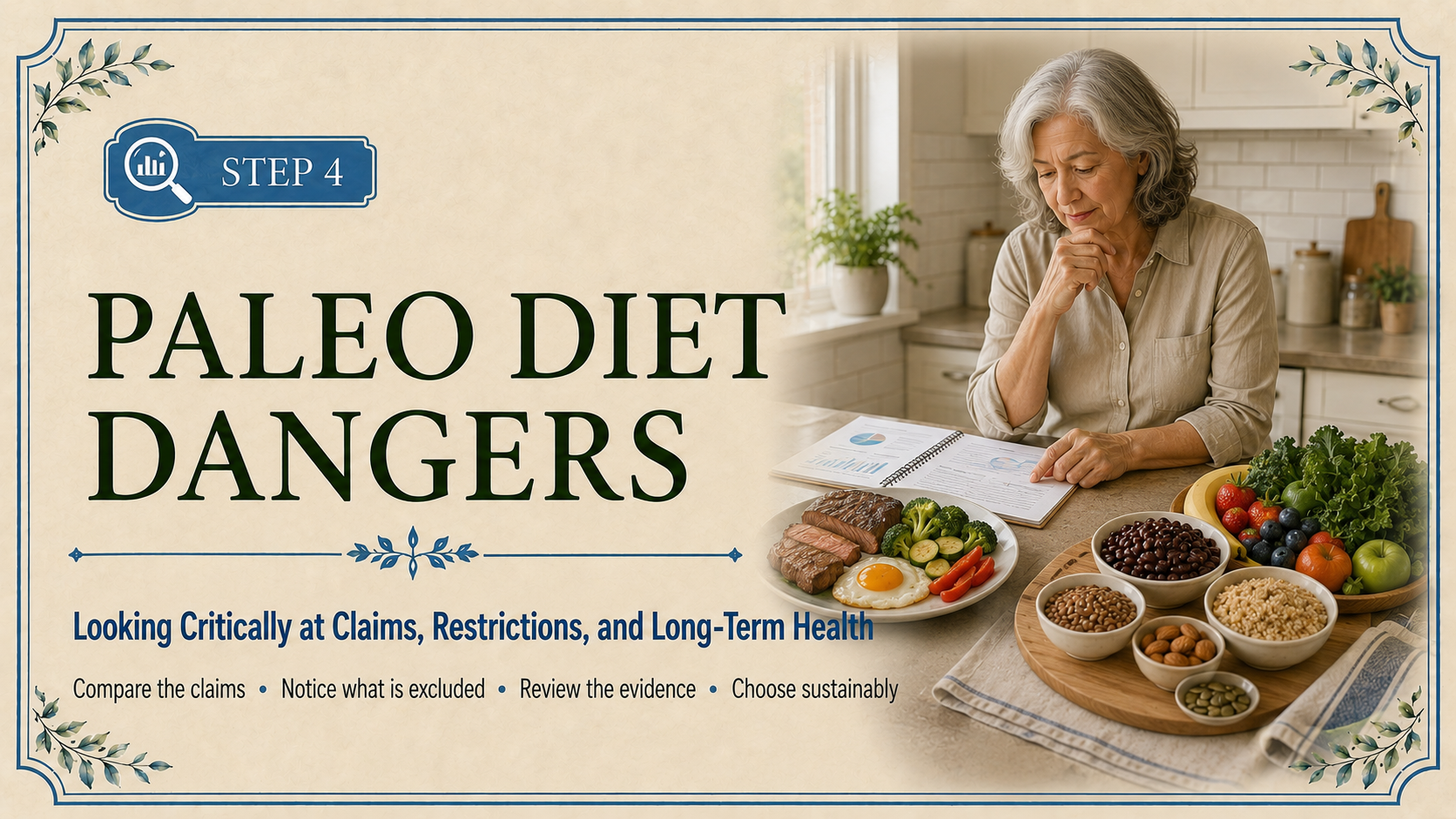
Introduction - Paleo Diet Dangers
A Clear, Evidence‑Aligned Look at the Risks
Many people are drawn to the Paleo diet because it promises a return to “natural” eating and a healthier, fitter life. But before you jump in, it’s important to understand what this diet actually promotes — and the potential risks that come with its high‑fat, meat‑heavy approach.
This isn’t a “food to avoid,” but it is a dietary pattern worth examining with care.
What the Paleo Diet Claims
Paleo advocates say we should eat like our Paleolithic ancestors — mostly animal protein, some plants, and very few carbohydrates. Modern versions of the diet often emphasize:
- High fat intake (especially from animal sources)
- Moderate to high amounts of meat
- Low to moderate carbohydrates
- No calorie counting or portion guidance
Supporters argue that today’s chronic diseases stem from processed foods, refined carbs, and sedentary lifestyles — and that Paleo is the antidote.
What the Research Actually Shows
Some studies do show short‑term weight loss on Paleo‑style diets. But when you look closer, several issues emerge:
- Most studies compare Paleo to weak control diets, such as “healthy reference diets” that include low‑fat dairy and whole grains — not to whole‑food, plant‑based diets.
- No high‑quality research compares Paleo to a plant‑strong diet, which is the gold standard for heart health, diabetes reversal, and long‑term disease prevention.
- Many Paleo variations are extremely high in saturated fat, which is strongly linked to heart disease risk.
- The diet’s sustainability is questionable, especially when it restricts fiber‑rich foods that support gut health and long‑term metabolic stability.
In other words: Paleo may help you lose weight in the short term, but weight loss alone doesn’t equal long‑term health.
Paleo Diet by Christina Warinner (Video)
Christina Warinner is an archaeological scientist, who debunks the notion behind paleolithic fad diets. Christina claims the fad started in the 70’s with the Stone Age Diet, and then reappeared as the Primal Blueprint, Paleo, and Neander Thin diets. All of these diets are based on the idea that “we should abandon our modern agricultural diets, which are making us sick, and move far back in time to our paleolithic ancestors more than 10,000 years ago, and eat like them.”
The Real Dangers of a High‑Fat, Meat‑Heavy Paleo Diet
Here’s where caution is truly needed:
1. High Saturated Fat Intake
Modern Paleo diets often rely heavily on red meat, eggs, and high‑fat animal products. This can raise LDL cholesterol and inflammation — two major drivers of heart disease.
2. Missing the Protective Power of Plants
By restricting whole grains, legumes, and some fruits, Paleo cuts out foods consistently shown to reduce chronic disease risk.
3. Misleading “Ancestral” Logic
Archaeological evidence shows our ancestors ate a wide range of diets depending on region and season — not a uniform meat‑heavy pattern. The modern Paleo diet is more myth than history.
4. Sustainability Concerns
High‑fat diets may feel satisfying at first, but long‑term adherence is low, and the health trade‑offs can be significant.
A Better Path: Whole‑Food, Plant‑Based Eating
Decades of research show that diets rich in whole, plant‑based foods:
- Lower cholesterol
- Improve blood pressure
- Reverse heart disease
- Support healthy weight
- Reduce inflammation
- Provide abundant fiber and antioxidants
A growing number of physicians now recommend plant‑based diets for patients with diabetes, heart disease, and cancer — because the results are consistent and powerful.
Paleo vs. Whole‑Food, Plant‑Based
A Clear, Reader‑Friendly Comparison
Feature | Paleo Diet | Whole‑Food, Plant‑Based Diet |
Primary Focus | High fat, meat‑centered, low carb | Plants, fiber, whole foods |
Protein Sources | Animal meats, eggs | Beans, lentils, tofu, whole grains |
Fat Intake | Often high, mostly saturated | Moderate, mostly unsaturated |
Carbohydrates | Restricted | Encouraged (whole, unprocessed) |
Chronic Disease Evidence | Limited, mixed, short‑term | Strong, long‑term, well‑documented |
Heart Health | Potential LDL increase | LDL reduction, improved vascular health |
Weight Loss | Possible short‑term | Sustainable long‑term |
Sustainability | Difficult for many | High adherence, flexible |
Philosophy | “Eat like ancestors” | “Eat foods proven to heal” |
Final Thoughts / Conclusion
The Paleo diet promises simplicity, weight loss, and a return to ancestral wisdom—but the reality is far more complicated. High saturated fat intake, limited fiber, and the exclusion of proven protective foods create risks that are easy to overlook when the marketing is loud and the short‑term results feel encouraging. What matters most is not whether a diet is trendy or nostalgic, but whether it supports your heart, your metabolism, your digestion, and your long‑term vitality.
Stepping away from meat‑heavy patterns isn’t about deprivation. It’s about choosing foods that nourish you deeply and consistently. Whole‑food, plant‑based eating continues to stand out because it aligns with decades of research, supports sustainable habits, and gives your body the nutrients it needs to thrive. Whatever path you choose, let it be intentional, informed, and rooted in the belief that your health is worth protecting—today and for years to come.
Author's Note
When I first began exploring the science behind popular diets, I was struck by how often strong opinions overshadow solid evidence. The Paleo diet is a perfect example. It’s marketed as a return to “natural” eating, yet the modern version looks nothing like the diverse, plant‑rich diets of actual hunter‑gatherer societies. My intention with this article isn’t to criticize anyone’s choices, but to offer clarity in a space crowded with hype. If you’ve ever felt confused about whether high‑fat, meat‑heavy diets truly support long‑term health, you’re not alone. My hope is that this piece helps you make decisions that feel grounded, confident, and aligned with the future you want for your body.
---- Robert
Continue The Conversation
Every wellness journey is unique, and we can learn a great deal from one another's experiences.
What stood out to you in this article?
Have you faced similar challenges, discovered helpful strategies, or gained insights of your own?
I invite you to share your thoughts in the comments below. Your experience may encourage someone else who is taking the next step on their own journey.
Remember, meaningful change often begins with a single step—and none of us has to walk the path alone.
Reference List
Clifton, P. M. & Keogh, J. B. (2017). A systematic review of the effect of dietary saturated and polyunsaturated fat on heart disease. Nutrition 27(12), pp. 1060-1080. https://doi.org/10.1016/j.numecd.2017.10.010
(2018). Diet Review: Paleo Diet for Weight Loss. Harvard T.H. Chan School of Public Health. https://www.hsph.harvard.edu/nutritionsource/what-should-you-eat/dietary-guidelines/paleo-diet/
A, G., R, M., P, C., et al. (2019). Low-Carb Paleo Diet Linked with Unhealthy Changes to Gut Microbiome. European Journal of Nutrition. https://doi.org/10.1007/s00394-019-02036-y
(2024). Plant-Based Diets and Diabetes Risk: Which Foods, What Mechanisms?. Diabetes Care 47(5), pp. 787-794. https://doi.org/10.2337/dci20-0070
Feingold, K. R. (2024). The Effect of Diet on Cardiovascular Disease and Lipid and Lipoprotein Levels. Endotext. https://www.ncbi.nlm.nih.gov/books/NBK570127/
(1999). Cereals, legumes, and chronic disease risk reduction: evidence from epidemiologic studies. The American Journal of Clinical Nutrition 70(3). https://doi.org/10.1093/ajcn/70.3.451s
(2020). Stable isotope evidence of diet breadth expansion and regional dietary variation among Middle-to-Late Holocene Hunter-Gatherers of Central California. Journal of Archaeological Science: Reports 29. https://doi.org/10.1016/j.jasrep.2019.102182
(2026). Low-Fat Diet - StatPearls - NCBI Bookshelf. StatPearls Publishing. https://www.ncbi.nlm.nih.gov/sites/books/NBK553097/
Tomé-Carneiro, J. & Visioli, F. (2023). Plant-Based Diets Reduce Blood Pressure: A Systematic Review of Recent Evidence. Current Hypertension Reports 25. https://doi.org/10.1007/s11906-023-01243-7
Mozaffarian, D. (2024). Plant-Based Diets and Diabetes Risk: Which Foods, What Mechanisms?. Diabetes Care 47(5). https://doi.org/10.2337/dci24-0011
Colón, S. (n.d.). Paleo diet | Description, Origins, Foods, Pros, & Cons. Britannica. https://www.britannica.com/topic/Paleo-diet
Disclaimer
The information provided in this article is for educational and informational purposes only and is not intended as medical, psychological, or professional advice. The content reflects general wellness principles and personal development concepts designed to encourage self-reflection and healthy lifestyle choices.
Individual circumstances vary, and readers should consult qualified healthcare professionals, mental health providers, or other appropriate experts regarding specific concerns or conditions. Never disregard professional advice or delay seeking help because of information contained in this article.
The author and publisher assume no responsibility for actions taken based on the information presented. Your health and well-being are ultimately your responsibility, and any changes to your lifestyle should be made thoughtfully and in consultation with appropriate professionals when necessary.