Introduction
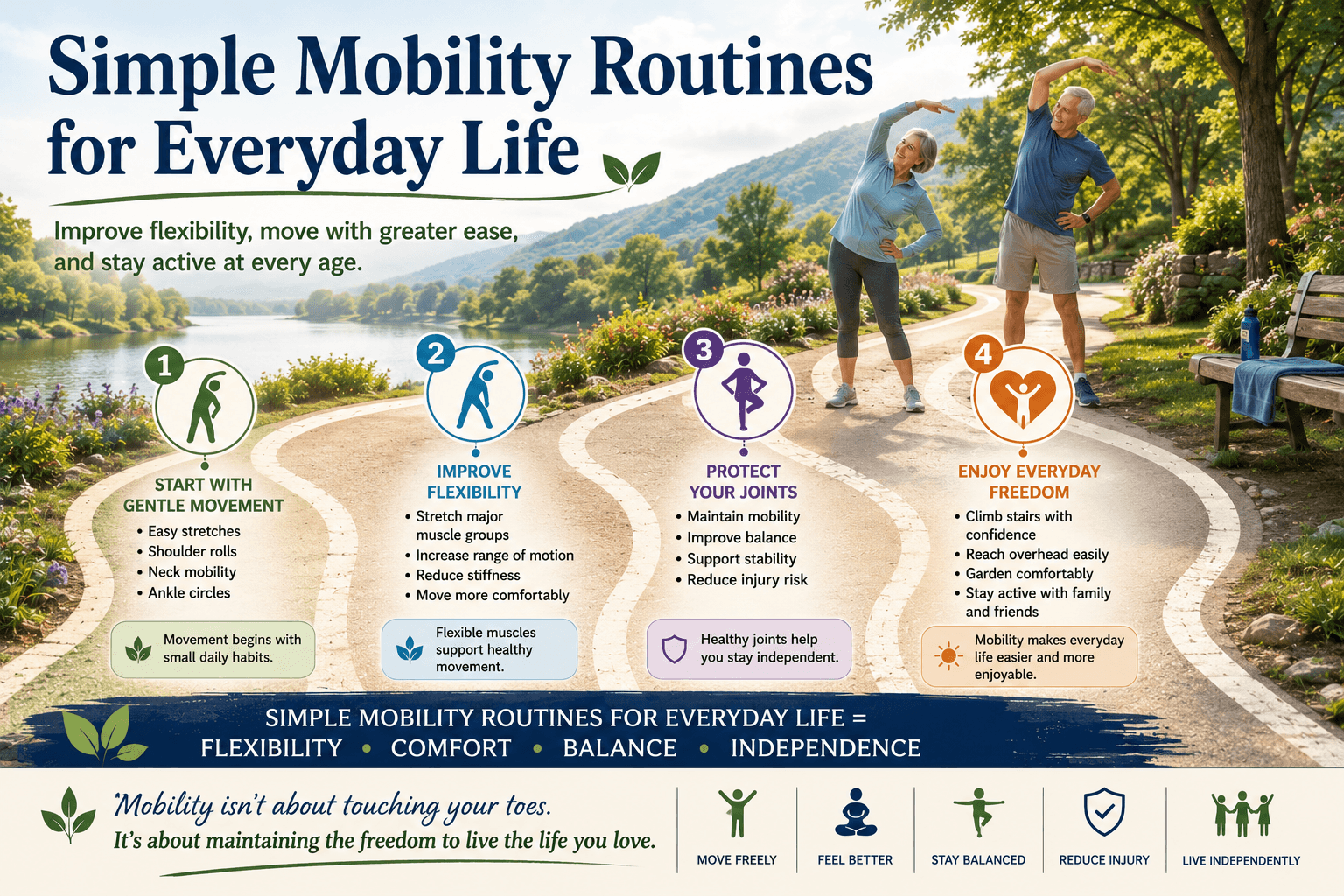
Mobility is the foundation of how you move through the world — how you bend, reach, twist, stand, walk, and stay steady. You don’t need long workouts or complicated routines to keep your body feeling free and capable. Simple, consistent mobility work helps you stay flexible, stable, and pain-free as you age. (Benefits of Flexibility and How To Improve It, 2024)
This post offers easy, approachable routines you can weave into daily life — no equipment, no pressure, just gentle movement that keeps your body feeling good.
Why Mobility Matters
Mobility is more than stretching. It’s your ability to move your joints through their full range of motion with control and ease. (MD, 2026) When mobility is limited, everyday tasks become harder: getting up from the floor, reaching overhead, turning your head while driving, or walking comfortably. (Physical Activity for People with Disability, 2025)
Regular mobility work helps you:
- Maintain joint health and reduce stiffness.
- Improve balance and stability.
- Support better posture and alignment.
- Reduce the risk of injury.
- Move with confidence in daily life.
- Age with strength, freedom, and ease. (Health Benefits of Physical Activity for Adults, 2026)
Mobility is one of the simplest ways to support long-term vitality and takes only a few minutes a day. (Benefits of flexibility exercises, 2015)
Core Themes of This Post
- Gentle, consistent movement: small routines done daily matter more than long sessions.
- Functional mobility — movements that support real‑life tasks.
- Joint health — keeping your hips, spine, shoulders, and ankles moving well.
- Ease over intensity — mobility should feel good, not forced.
- Integration into daily life: routines you can do while waiting for coffee, watching TV, or winding down at night.
Simple Mobility Framework: The Four Everyday Zones
1. Spine Mobility
Your spine is your central support system. Keeping it mobile helps with posture, balance, and daily comfort.
Try:
- Cat‑cow (gentle flexion/extension)
- Seated or standing spinal twists
- Slow side bends
Why it matters:
A mobile spine reduces stiffness, supports breathing, and helps you stay upright and balanced. (30 Tips for Spine Health Prevention & Wellness, 2024)
2. Hip Mobility
Your hips power walking, standing, bending, and balance.
Try:
- Hip circles
- Figure‑four stretch
- Gentle lunges with a reach
Why it matters:
Healthy hips protect your lower back, improve your gait, and support stability as you age. (Health Benefits of Physical Activity for Adults, 2026)
3. Shoulder & Upper‑Back Mobility
Modern life tightens the upper body: screens, driving, sitting.
Try:
- Arm circles
- Wall angels
- Chest‑opening stretches
Why it matters:
Better shoulder mobility improves posture, reduces tension, and eases lifting and reaching. (PT & MD, 2023)
4. Ankle & Foot Mobility
Your feet and ankles are your foundation.
Try:
- Ankle circles
- Toe lifts and heel raises
- Gentle calf stretches
Why it matters:
Strong, mobile ankles improve balance and walking comfort and help prevent falls. (Raz et al., 2024)
How to Start Today
You don’t need a full routine; just a few minutes sprinkled throughout your day.
Try one or more of these:
- Do a 3‑minute morning mobility flow (spine, hips, shoulders).
- Add ankle circles while the water boils.
- Do gentle twists during TV commercials.
- Take movement breaks every hour; 1–2 minutes is enough.
- End your day with slow stretches to unwind your body and mind.
Small steps compound, and your joints respond quickly to consistency. (8 Ways Exercise Helps Your Joints, n.d.)
Conclusion
Mobility isn’t about performance; it’s about freedom. The freedom to move through your day with ease, to bend and reach without pain, to feel steady and capable in your own body. These simple routines aren’t just exercises; they’re acts of care, small daily choices that support your long-term vitality.
You don’t need perfect form or long sessions. You just need consistency, curiosity, and willingness to reconnect with your body. Every gentle twist, stretch, and circle is a step toward strength, stability, and self-trust.
Start small. Stay consistent. Let movement become a quiet, powerful part of your everyday life.
Author’s Note
Mobility has been one of the most transformative parts of my wellness journey. Not because it’s intense or impressive, but because it’s simple, grounding, and sustainable. A few minutes of gentle movement each day has helped me feel more open, steady, and capable, especially during busy seasons of life.
My hope is that these routines help you reconnect with your body in a way that feels supportive, not stressful. You don’t need perfection. You just need to begin.
---- Robert
Continue The Conversation
Every wellness journey is unique, and we can learn a great deal from one another's experiences.
What stood out to you in this article?
Have you faced similar challenges, discovered helpful strategies, or gained insights of your own?
I invite you to share your thoughts in the comments below. Your experience may encourage someone else who is taking the next step on their own journey.
Remember, meaningful change often begins with a single step—and none of us has to walk the path alone.
Reference List
(2024). Benefits of Flexibility and How To Improve It. Cleveland Clinic. https://health.clevelandclinic.org/how-to-improve-flexibility-and-benefits
MD, R. H. (2026). Mobility - Harvard Health. Harvard Health. https://www.health.harvard.edu/topics/mobility
(2025). Physical Activity for People with Disabilities. Centers for Disease Control and Prevention. https://www.cdc.gov/disability-and-health/articles-documents/physical-activity-for-people-with-disability.html
(2026). Health Benefits of Physical Activity for Adults. Centers for Disease Control and Prevention. https://www.cdc.gov/physical-activity-basics/health-benefits/adults.html
(2015). Benefits of flexibility exercises. Harvard Health Publishing. https://www.health.harvard.edu/staying-healthy/benefits-of-flexibility-exercises
(2024). 30 Tips for Spine Health Prevention & Wellness. National Spine Health Foundation. https://spinehealth.org/article/spine-health-wellness/
PT, K. G. & MD, S. S. (2023). 7 Shoulder Exercises That Improve Shoulder Mobility. GoodRx. https://www.goodrx.com/well-being/movement-exercise/shoulder-mobility-exercises
Raz, D., Joshi, V., Umberger, B. R., & Ozay, N. (2024). Ankle Exoskeletons May Hinder Standing Balance in Simple Models of Older and Younger Adults. arXiv preprint. https://doi.org/10.48550/arXiv.2408.05418
(n.d.). 8 Ways Exercise Helps Your Joints. Arthritis Foundation. https://www.arthritis.org/health-wellness/healthy-living/physical-activity/getting-started/8-ways-exercise-helps-joints
Pietrangelo, A. (2019). Gentle Exercises to Help Digestion: Yoga, Tai Chi, and More. Healthline. https://www.healthline.com/health/epi/exercises-digestion
Devoy, R. & Maguire, R. (2024). Effects of mindfulness and movement on affect and vitality. Work 78(4), pp. 1213-1223. https://doi.org/10.3233/WOR-230650
Iterson, E. V. (May 15, 2025). Health Risks of a Sedentary Lifestyle. Cleveland Clinic. https://health.clevelandclinic.org/youre-sitting-too-much-how-to-sneak-in-more-steps/?cvo_creative=021219+steps&cvosrc=social+network.twitter.cc+tweets
Disclaimer
The information provided in this article is for educational and informational purposes only and is not intended as medical, psychological, or professional advice. The content reflects general wellness principles and personal development concepts designed to encourage self-reflection and healthy lifestyle choices.
Individual circumstances vary, and readers should consult qualified healthcare professionals, mental health providers, or other appropriate experts regarding specific concerns or conditions. Never disregard professional advice or delay seeking help because of information contained in this article.
The author and publisher assume no responsibility for actions taken based on the information presented. Your health and well-being are ultimately your responsibility, and any changes to your lifestyle should be made thoughtfully and in consultation with appropriate professionals when necessary.