Introduction
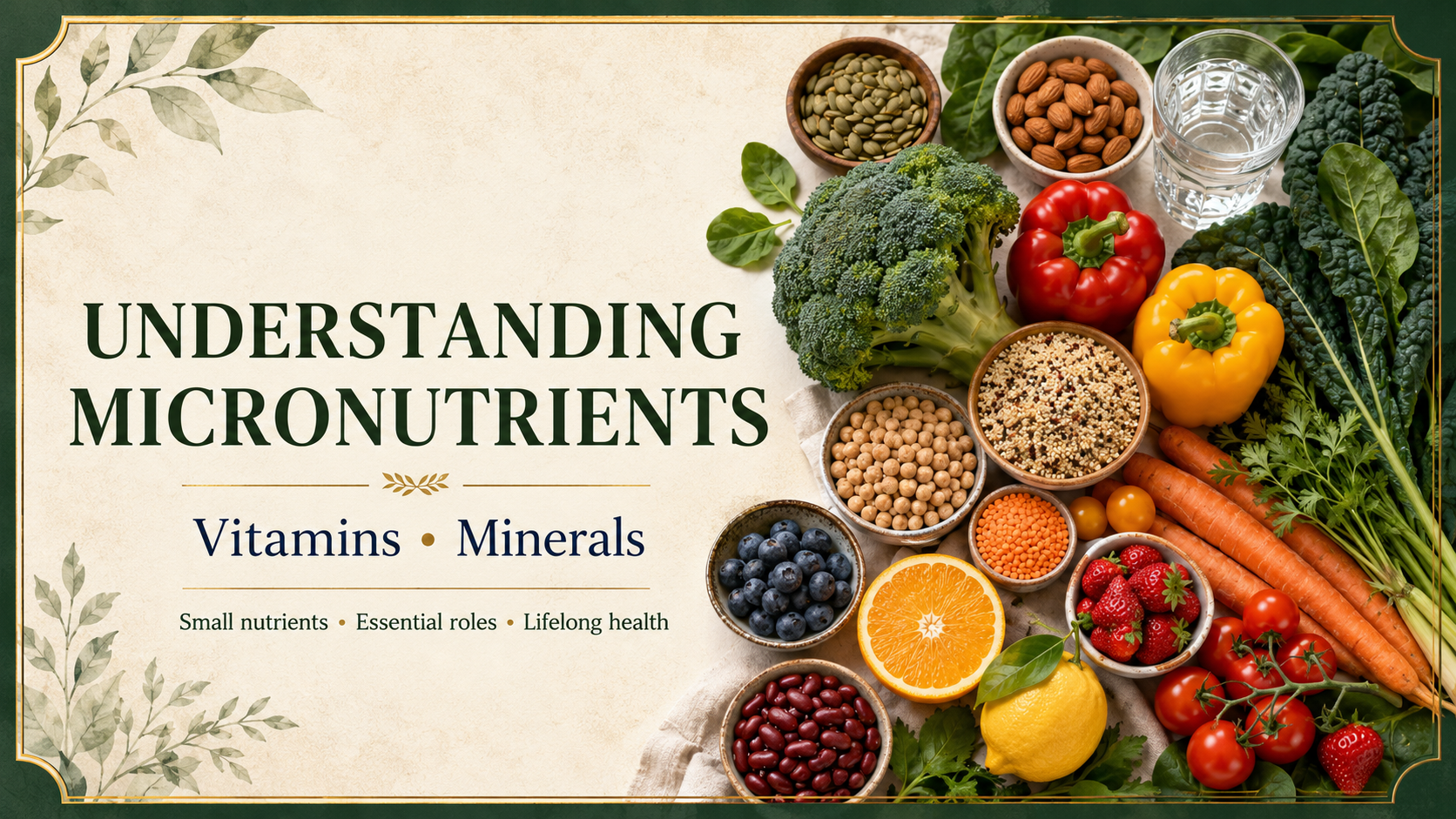
Micronutrients—vitamins, minerals, and phytonutrients—are needed in small amounts, but their impact is enormous. They power your metabolism, strengthen your bones, support your immune system, and keep your cells functioning at their best. When you understand how these nutrients work, it becomes easier to choose foods that help your body thrive.
Vitamins: Your Body’s Spark Plugs
Vitamins help convert food into energy, repair tissues, and protect your cells from damage. They support everything from immunity to brain function, and each group plays a unique role in keeping you healthy. (Barker, 2023)
Key vitamins and what they do:
- B vitamins — support energy production, metabolism, and brain function (Hanna et al., 2022)
- Vitamin C — strengthens immunity and supports collagen formation. (Carr & Maggini, 2017)
- Vitamin D — essential for bone health, mood, and immune function (Chauhan et al., 2023)
- Vitamin A — supports vision, skin health, and cellular repair (McEldrew et al., 2025)
- Vitamin E — protects cells from oxidative stress. (Al-Sowayan, 2020, pp. 2563-2566)
Whole‑food sources: leafy greens, citrus fruits, berries, nuts, seeds, whole grains, fortified plant milks, sweet potatoes, and legumes.
Minerals: Your Body’s Structural Support
Minerals keep your bones strong, your heart beating, and your nerves firing. They also help regulate fluid balance, muscle contraction, and enzyme activity. (Health, 1989)
Important minerals and their roles:
- Calcium — supports bones, teeth, and muscle function. (Crowley, 2023)
- Magnesium — aids relaxation, metabolism, and nerve function
- Iron — transports oxygen throughout the body. (Burri & Editors, 2023)
- Zinc — supports immunity, healing, and DNA repair. (Jafari et al., 2022, pp. 3023-3041)
- Potassium — helps regulate blood pressure and fluid balance. (Filippini et al., 2020)
Whole‑food sources: beans, lentils, nuts, seeds, leafy greens, whole grains, tofu, fortified foods, and fruits like bananas and oranges.
Phytonutrients: Nature’s Protective Compounds
Phytonutrients (also called phytochemicals) are natural compounds found in plant foods that help reduce inflammation, protect your cells, and support long‑term health. They aren’t considered “essential” like vitamins and minerals, but they play a powerful role in disease prevention and overall vitality. (Poulsen et al., 2020)
Common phytonutrient groups include:
- Carotenoids — found in orange and dark‑green vegetables; support eye and immune health (Kaleem, 2024)
- Flavonoids — found in berries, tea, citrus, and onions; support heart and brain health (Effects of chronic consumption of specific fruit (berries, cherries, and citrus) on cognitive health: a systematic review and meta-analysis of randomized controlled trials, 2022)
- Polyphenols — found in herbs, spices, coffee, and dark chocolate; reduce inflammation (Oxidative Stress and Inflammation: What Polyphenols Can Do for Us?, 2014)
- Glucosinolates — found in broccoli, kale, and cabbage; support detoxification (Maina et al., 2020)
Eating a variety of colorful plant foods ensures you get a wide spectrum of these protective compounds. (Exploring the benefits of phytonutrients, 2024)
You might wonder if food alone is enough to supply these micronutrients. Let’s briefly consider the role of supplements.
Most micronutrients can come from whole foods, but supplements can help fill gaps—especially vitamin D, vitamin B12, or iron, depending on your diet and lifestyle. Supplements should support your nutrition, not replace it. (A, 2020)
If you are considering supplements, choose brands that are third-party tested and consult a healthcare professional to address your individual needs.
To make meeting your micronutrient needs easier, here are some daily strategies you can use:
- Eat a variety of colorful fruits and vegetables.
- Include leafy greens daily.
- Choose whole grains over refined grains.
- Add nuts, seeds, and legumes for minerals and healthy fats.
- Rotate your plant foods for nutrient diversity.
- Use supplements only to fill specific gaps.
Small, consistent habits make the biggest difference.
Conclusion
Micronutrients may be small, but their impact is significant. Vitamins, minerals, and phytonutrients support key areas such as energy, immunity, metabolism, and well-being—often in subtle yet vital ways. By eating a variety of colorful, whole foods, you naturally fuel your body with the nutrients it needs.
You don’t have to track every nutrient or aim for perfection. Simply choosing more fruits, vegetables, legumes, nuts, seeds, and whole grains creates a strong foundation. Over time, these small, consistent choices add up, helping you feel more energized, balanced, and connected to your health. Let this guide you toward meals that nourish you from the inside out.
Author’s Note
My hope with this guide is to make micronutrients feel less mysterious and more approachable. For years, I thought eating well meant tracking every vitamin and mineral—but what truly changed my health was learning how simply the body responds when we focus on whole, colorful foods. Once you understand the basics, nourishing yourself becomes much easier.
You don’t need to memorize charts or chase perfection. Keep adding variety, choose real foods, and pay attention to how your body feels. Over time, these steady choices create a foundation of health that supports your energy, immunity, and well-being. I’m here to help you feel empowered on your journey.
— Robert
Share Your Thoughts and Experiences
Readers are invited to share which points resonated with them. If this post raised a question or insight, sharing experiences can help others feel supported on their wellness journey. Comment below to join the discussion.
Reference List for Understanding Micronutrients
Barker, T. (2023). Vitamins and Human Health: Systematic Reviews and Original Research. Nutrients 15(13). https://doi.org/10.3390/nu15132888
Hanna, M., Jaqua, E., Nguyen, V. & Clay, J. (2022). B Vitamins: Functions and Uses in Medicine. The Primary Care Companion for CNS Disorders 26(2). https://doi.org/10.7812/TPP/21.204
Carr, A. C. & Maggini, S. (2017). Vitamin C and Immune Function. Nutrients 9(11). https://doi.org/10.3390/nu9111211
Chauhan, K., Shahrokhi, M. & Huecker, M. R. (2023). Vitamin D - StatPearls. NCBI Bookshelf. https://www.ncbi.nlm.nih.gov/books/NBK441912/
McEldrew, E. P., Lopez, M. J., & Milstein, H. (2025). Vitamin A - StatPearls - NCBI Bookshelf. StatPearls Publishing. https://www.ncbi.nlm.nih.gov/books/NBK482362/
Al-Sowayan, N. S. (2020). Possible modulation of nervous tension-induced oxidative stress by vitamin E. Saudi J Biol Sci 27(10), pp. 2563-2566. https://doi.org/10.1016/j.sjbs.2020.05.018
Health, N. R. (1989). Minerals - Diet and Health. National Academies Press. https://www.ncbi.nlm.nih.gov/books/NBK218735/
Crowley, R. (2023). Got Calcium?. National Institute of General Medical Sciences. https://nigms.nih.gov/biobeat/2023/02/got-calcium
Burri, P. H. & Editors, B. (2023). Human respiratory system - Oxygen Transport, Lungs, Airways. Britannica. https://www.britannica.com/science/human-respiratory-system/Transport-of-oxygen
Jafari, A., Noormohammadi, Z., Askari, M. & Daneshzad, E. (2022). Zinc supplementation and immune factors in adults: a systematic review and meta-analysis of randomized clinical trials. Critical Reviews in Food Science and Nutrition 62(11), pp. 3023-3041. https://doi.org/10.1080/10408398.2020.1862048
Filippini, T., Naska, A., Kasdagli, M., Torres, D., Lopes, C., Carvalho, C., Moreira, P., Malavolti, M., Orsini, N., Whelton, P. K. & Vinceti, M. (2020). Potassium Intake and Blood Pressure: A Dose-Response Meta-Analysis of Randomized Controlled Trials. Journal of the American Heart Association 9(12). https://doi.org/10.1161/JAHA.119.015719
Poulsen, N. B., Lambert, M. N. & Jeppesen, P. B. (2020). The Effect of Plant-Derived Bioactive Compounds on Inflammation: A Systematic Review and Meta-Analysis. Mol Nutr Food Res 64(18). https://doi.org/10.1002/mnfr.202000473
Kaleem, M. (2024). Nutrition and Eye Health. Johns Hopkins Medicine. https://www.hopkinsmedicine.org/health/wellness-and-prevention/nutrition-and-eye-health
(2022). Effects of chronic consumption of specific fruit (berries, cherries, and citrus) on cognitive health: a systematic review and meta-analysis of randomized controlled trials. European Journal of Clinical Nutrition. https://doi.org/10.1038/s41430-022-01138-x
(2014). Oxidative Stress and Inflammation: What Polyphenols Can Do for Us?. Frontiers in Nutrition 1. https://doi.org/10.3389/fnut.2014.00014
Maina, S., Misinzo, G., Bakari, G. & Kim, H. (2020). Human, Animal, and Plant Health Benefits of Glucosinolates and Strategies for Enhanced Bioactivity: A Systematic Review. Molecules 25(16). https://doi.org/10.3390/molecules25163682
(May 14, 2024). Exploring the benefits of phytonutrients. Nature. https://www.nature.com/articles/d42473-024-00291-0
A, M. (2020). Bioavailability of Micronutrients From Nutrient-Dense Whole Foods: Zooming in on Dairy, Vegetables, and Fruits. Front. Nutr. 7:101. https://doi.org/10.3389/fnut.2020.00101
Disclaimer
This article is for educational and informational purposes only. It is not intended to diagnose, treat, cure, or prevent any disease. The content reflects current research on nutrition, chronic disease, and dietary patterns in the United States, but it should not replace personalized guidance from a qualified healthcare professional.
Everyone’s health situation is unique. If you have medical concerns, dietary restrictions, or chronic conditions, please consult your physician, registered dietitian, or another licensed healthcare provider before making significant changes to your diet or lifestyle.