Introduction
With so many plant‑based diets gaining attention today, it’s easy to feel overwhelmed by the labels, rules, and trends. Vegan, vegetarian, flexitarian, Mediterranean — each offer something valuable, yet not all of them deliver the clarity and results people truly need. Plant‑Strong cuts through the noise. Built on whole, unprocessed foods and grounded in decades of clinical evidence, it offers a simple, powerful path to better health. This approach isn’t about restriction — it’s about nourishment, energy, and long‑term transformation. If you’ve ever wondered which plant‑based lifestyle delivers the greatest impact, this is where the difference becomes clear.
What Plant‑Strong Really Means
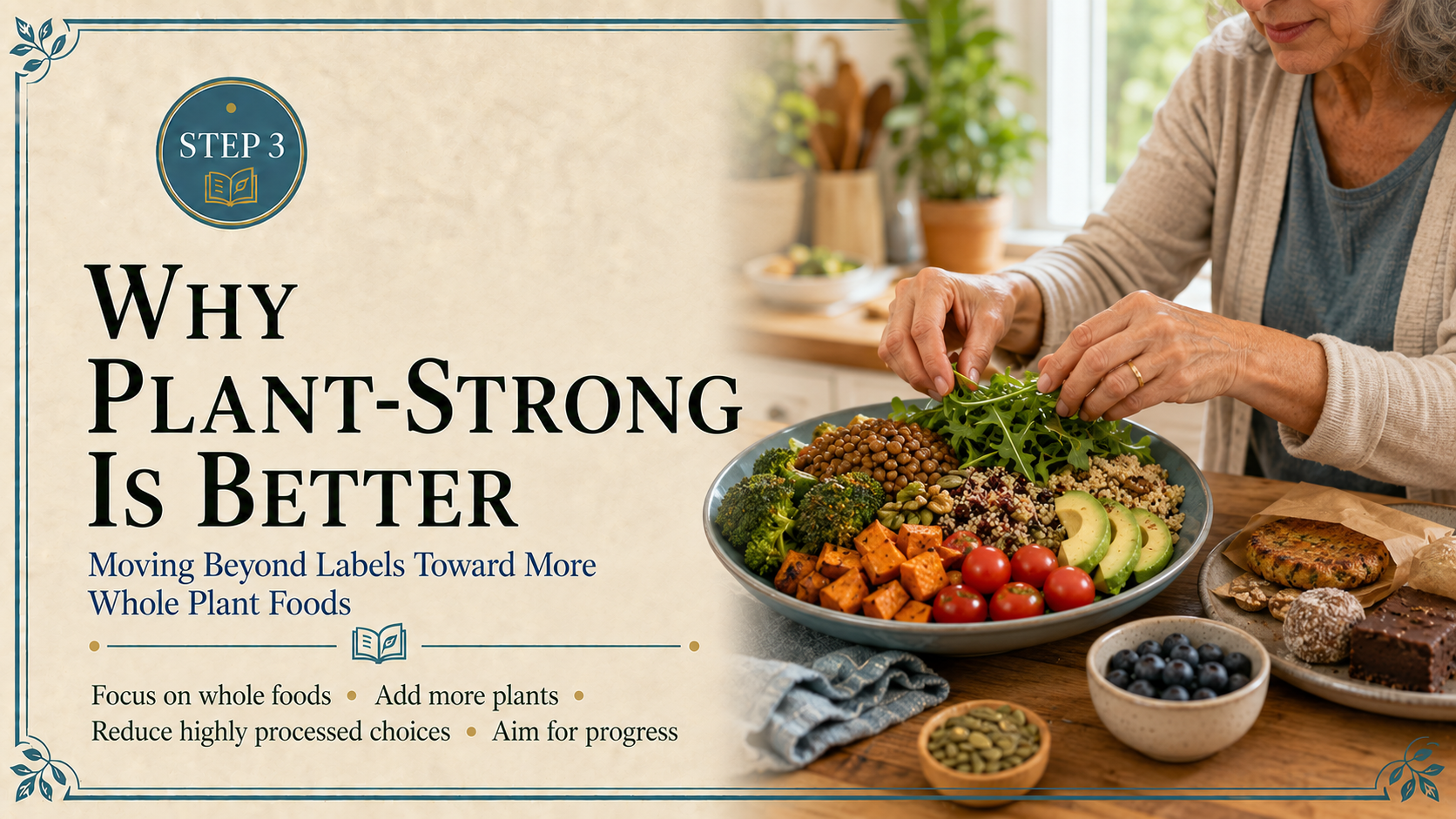
Plant-Strong, popularized by Rip’s Engine 2 Diet, focuses on whole, unprocessed plant foods. By adopting this approach, you commit to:
- Whole grains only — no refined grains
- Beans, legumes, vegetables, fruits, nuts, and seeds
- Zero added oils
- Zero processed vegan substitutes.
- Zero animal products
This is not about fake meats, cheeses, or ultra-processed plant-based products. Rip emphasizes this because many vegan foods are as processed and unhealthy as what they replace. (Stokes, 2024)
Plant‑Strong is about real food. Food that grows from the ground. Food that nourishes, heals, and strengthens.
The Esselstyn Legacy: Proven Results, Not Trends
Rip’s father, Dr. Caldwell Esselstyn, spent decades at the Cleveland Clinic. He became one of the most influential voices in lifestyle-based disease reversal. His research demonstrated something extraordinary: heart disease — our #1 killer — can be prevented and even reversed through a whole-food, plant-based diet (An unbiased, sustainable, evidence-informed Universal Food Guide: a timely template for national food guides, 2024) (Ornish et al., 1998, pp. 2001-2007).
This wasn’t a theory. It wasn’t marketing. It was clinical evidence.
The Plant‑Strong movement stands on that foundation: science, results, and a deep belief that food should heal, not harm.
Why Plant‑Strong Is Better Than Other Plant‑Based Approaches
Many plant‑based diets allow:
- Oils
- Refined grains
- Vegan substitutes
- Processed snacks
- High‑fat plant foods without limits
Plant-Strong draws a clear line and removes confusion. It eliminates loopholes. It focuses on foods that deliver the best outcomes for weight, heart health, energy, digestion, and long-term disease prevention (Neuenschwander et al., 2023).
It’s not restrictive — it’s liberating. You eat abundantly, but you eat intentionally.
Food Is Supposed to Nourish
At its core, Plant‑Strong and Whole‑Food Plant‑Based (WFPB) are aligned. Both emphasize:
- Whole, natural foods
- Daily nourishment
- Long‑term health
- Sustainable lifestyle change
People don’t die from a lack of calories. Instead, they die from malnutrition (A et al., 2017). A Plant-Strong lifestyle brings back what the modern diet has stripped away.
Think Plant‑Strong. Think whole foods. Think long‑term health.
Where to Begin
Rip invites you — and anyone you care about — to learn more through the Plant Strong story and the growing Plant-Strong community. Ready for a reboot? Exploring plant-based living for the first time? These resources are great starting points:
The Forks Over Knives Plan makes it easier to transition to this healthiest way of eating and maintain it for life.
Below are other great resources that will help you get on the right track.
The Plant-Based Solution: America’s Healthy Heart Doc’s Plan to Power Your Health
How Not to Die: Discover the Foods Scientifically Proven to Prevent and Reverse Disease
These books and programs make the transition simple, practical, and sustainable.
Author's Note
The Plant-Strong approach has been close to my heart for many years. I’ve seen people transform their energy, confidence, and long-term health by shifting toward whole, unprocessed plant foods. They often do it one small step at a time. My goal with this article is to cut through the noise and offer a clear, encouraging path. It’s grounded in both science and my lived experience.
You don’t need perfection to benefit from whole plants. You just need a willingness to explore, experiment, and reconnect with foods that truly nourish your body. Whether you’re starting new or already living this way, I hope this guide gives clarity, motivation, and possibility.
Thank you for being part of this journey toward a healthier, more intentional life.
— Robert
Continue The Conversation
Every wellness journey is unique, and we can learn a great deal from one another's experiences.
What stood out to you in this article?
Have you faced similar challenges, discovered helpful strategies, or gained insights of your own?
I invite you to share your thoughts in the comments below. Your experience may encourage someone else who is taking the next step on their own journey.
Remember, meaningful change often begins with a single step—and none of us has to walk the path alone.
Reference List
Harvard T.H. Chan School of Public Health. (2024).
Plant‑Forward Eating and Long‑Term Health.
Evidence on whole‑food dietary patterns, chronic disease risk, and nutrient density.
Mayo Clinic Staff. (2024).
Whole‑Food, Plant‑Based Diet: Benefits and Getting Started.
Overview of WFPB principles, heart health, and metabolic benefits.
Cleveland Clinic. (2024).
Why Whole‑Food, Plant‑Based Eating Supports Better Health.
Research summary on inflammation, weight management, and disease prevention.
National Institutes of Health. (2024).
Dietary Patterns and Chronic Disease: Evidence for Whole‑Food Approaches.
Large cohort and clinical trial data comparing processed vs. whole‑food diets.
American Heart Association. (2024).
Plant‑Rich Diets and Cardiovascular Outcomes.
Guidance on fiber, antioxidants, and reduced saturated fat intake.
Campbell, T. C., & Campbell, T. M. (2023).
The China Study (Updated Edition).
Foundational epidemiological research supporting whole‑food, plant‑based nutrition.
Esselstyn, C. B. (2023).
Prevent and Reverse Heart Disease (Updated Research Edition).
Clinical outcomes from intensive whole‑food, plant‑based interventions.
Greger, M. (2023).
How Not to Diet: Evidence‑Based Nutrition for Weight and Metabolic Health.
Research on calorie density, whole‑food nutrition, and long‑term weight outcomes.
Neuenschwander, M., Stadelmaier, J., Eble, J., Grummich, K., Szczerba, E., Kiesswetter, E., Schlesinger, S. & Schwingshackl, L. (2023). Substitution of animal-based with plant-based foods on cardiometabolic health and all-cause mortality: a systematic review and meta-analysis of prospective studies. BMC Medicine 21. https://doi.org/10.1186/s12916-023-03093-1
Stokes, V. (June 12, 2024). Plant-Based Ultra-Processed Foods May Raise Your Risk of Heart Disease and Early Death. Healthline. https://www.healthline.com/health-news/plant-based-ultra-processed-foods-heart-disease-early-death
Ornish, D., Scherwitz, L. W., Billings, J. H., Brown, S. E., Gould, K. L., Merritt, T. A., Sparler, S., Armstrong, W. T., Ports, T. A., Kirkeeide, R. L., Hogeboom, C., & Brand, R. J. (1998). Intensive lifestyle changes for reversal of coronary heart disease. JAMA 280(23), pp. 2001-2007. https://doi.org/10.1001/jama.280.23.2001
(2024). An unbiased, sustainable, evidence-informed Universal Food Guide: a timely template for national food guides. Nutrition Journal. https://doi.org/10.1186/s12937-024-01018-z
A, S., SN, B., D, S. & al., e. (2017). Plant-Based Diets and Coronary Heart Disease Risk. J Am Coll Cardiol 2017;70:411-422. https://doi.org/10.1016/j.jacc.2017.05.047