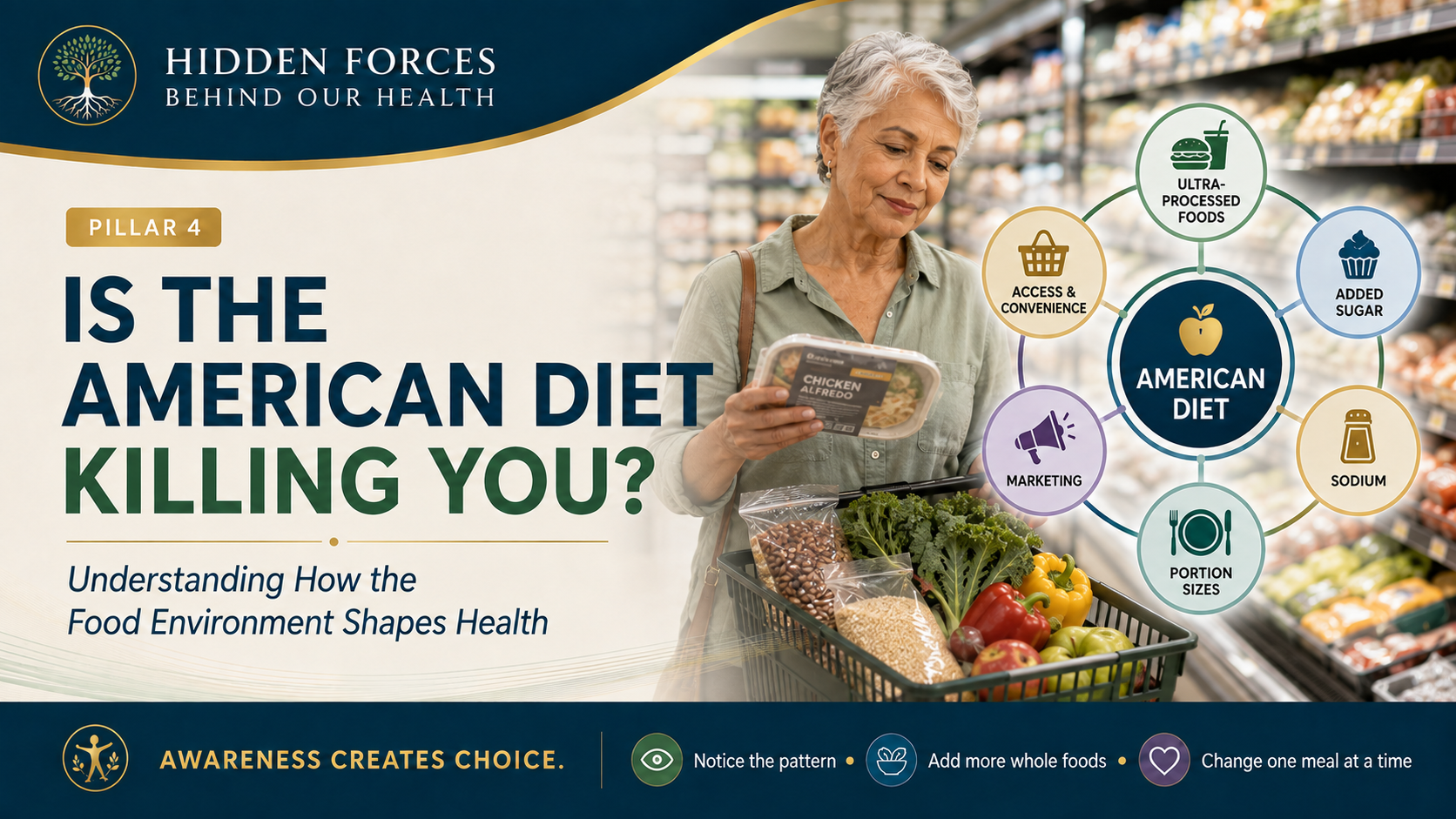
Is the American Diet Killing Us? Understanding the Crisis — and the Way Out
The Standard American Diet (SAD) extends beyond a mere reflection of national eating habits. Although it offers convenience and affordability, it serves as a primary driver of chronic disease, resulting in widespread undernutrition and poor health. The fundamental problem is that the most commonly consumed foods directly compromise public health.
This situation represents more than a health issue; collective dietary patterns have precipitated a national crisis, adversely affecting individuals and imposing significant burdens on society.
The Health Consequences of Dietary Convenience
The American food environment presents a paradox. Grocery stores offer fresh produce, whole grains, and healthy proteins. Compared to many countries, access to high-quality food is a national advantage.
Despite the abundance of available food, declining national health indicators reveal an urgent underlying problem: the most frequently consumed foods contribute to widespread illness.
This article forms part of a broader series examining the origins of national health challenges. Previous installments, such as Obesity Epidemic in America and The Food Health Crisis in America, have addressed the systemic factors influencing the food environment. This section focuses on a more specific question:
Given the widespread availability of nutritious food, why do high rates of diet-related illness persist among Americans?
The Hidden Cost of Convenience
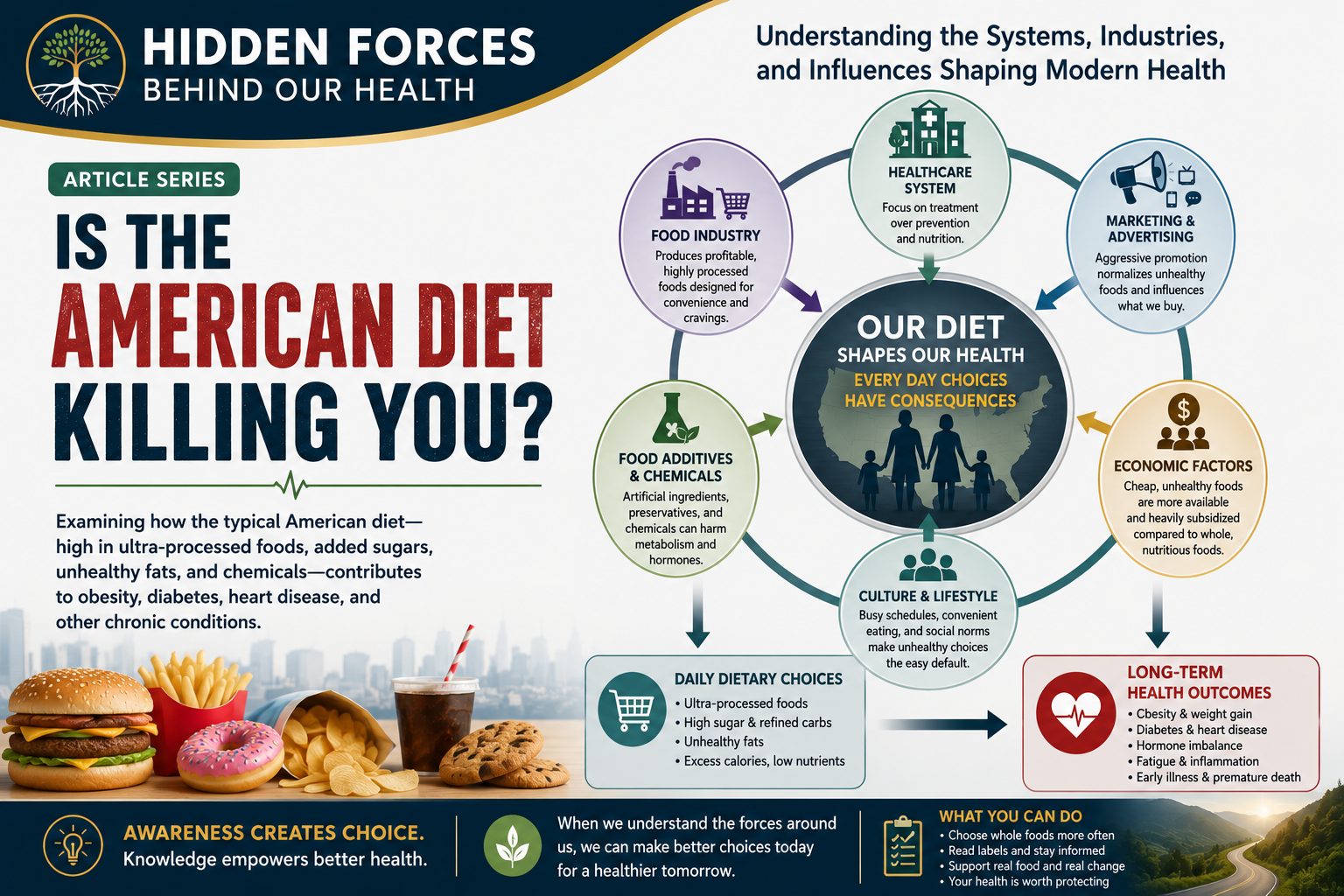
The Standard American Diet enshrines convenience and promotes foods engineered for repeat consumption. These choices—influenced by cost and ease—are at the heart of today’s health crisis.
The consequences of these dietary choices are evident throughout the population:
- Rising rates of obesity
- Increasing cases of type 2 diabetes
- Heart disease has become the nation's leading killer.
- Chronic inflammation and lifestyle-related illnesses are common. (Su et al., 2025)
Most Americans are consuming:
- too many calories
- too few nutrients
- too much sugar
- too much sodium
- This nutritional imbalance is a predictable outcome of a system that prioritizes speed and profit over real nourishment—directly fueling a national epidemic of chronic disease.
These are not isolated failures but symptoms of a national food culture that values convenience over genuine health, fueling the crisis.
Too Much of the Wrong Things, Too Little of the Right Ones
Most Americans do not lack willpower; the food environment encourages unhealthy choices.
Consider the imbalance:
- 63% of daily calories come from refined and ultra‑processed foods
- 25% come from animal‑based foods
- Only 12% come from plant‑based foods — and half of that is French fries.
Only 6% of the average American’s calories are from whole, health-promoting foods like fruits, vegetables, whole grains, nuts, and seeds. (Roubein, 2025)
Given these patterns, it is clear: the Standard American Diet is the driving force behind the nation’s high chronic disease rates. America’s health crisis is rooted in what we eat.
Portion Distortion: When “Normal” Became Excessive
Most Americans do not lack willpower; the food environment encourages unhealthy choices.
Consider the imbalance:
- 63% of daily calories come from refined and ultra‑processed foods
- 25% come from animal‑based foods
- Only 12% come from plant‑based foods — and half of that is French fries.
Only 6% of the average American’s calories are from whole, health-promoting foods like fruits, vegetables, whole grains, nuts, and seeds. (Roubein, 2025)
Given these patterns, it is clear: the Standard American Diet is the driving force behind the nation’s high chronic disease rates. America’s health crisis is rooted in what we eat.
A Culture Built on Fast, Cheap, and Everywhere
With over 170,000 fast-food restaurants and 3 million soda machines nationwide, calorie-dense foods are everywhere. Children and teens have even more exposure—many schools offer sugary drinks and processed snacks daily. A generation now grows up with normalized overeating, snacking, and excessive sugar, beyond what the body can handle.
The Hidden Deficiencies Behind the Excess
Despite eating more than ever, Americans are nutrient‑poor. According to national nutrition analyses, the SAD diet is consistently low in:
- fiber
- potassium
- calcium
- vitamin D
- antioxidants
- phytonutrients
These deficiencies weaken immunity, impair digestion, disrupt metabolism, and accelerate aging.
Even more concerning is the perception gap:
91% of Americans believe their diet is “good” or better, yet their eating patterns do not align with U.S. dietary guidelines. This disconnect fuels complacency — and prevents change.
The Real Cost: The Diseases We’re Creating
The long‑term consequences of the SAD diet are staggering. Regular consumption is linked to:
- obesity
- heart disease
- hypertension
- type 2 diabetes
- stroke
- digestive disorders
- cognitive decline
- certain cancers
The American Cancer Society links 18% of cancer cases to poor diet and inactivity. (American Cancer Society Guideline for Diet and Physical Activity for Cancer Prevention, 2024)
The Standard American Diet’s effects on health appear rapidly, demonstrating how closely our food choices and national health outcomes are linked.
A study published by the Royal Society found that just one week on a typical SAD diet can:
- impair learning
- reduce memory performance
- increase cravings for junk food (Stevenson et al., 2020)
This pattern establishes a self-perpetuating cycle: increased consumption of unhealthy foods reinforces neural pathways that promote continued intake.
It is therefore unsurprising that nearly 75% of Americans are overweight or obese. (Adult Obesity Facts, 2024) The Standard American Diet is intentionally formulated to encourage habitual consumption.
Why This Matters Now
The U.S. faces rapid increases in chronic disease, largely driven by food choices. This trend causes much suffering and economic loss, yet it is often overlooked as diet-related.
Still, there is reason for hope.
This trend is reversible with evidence-based dietary changes.
It Doesn’t Have to Be This Way
Encouragingly, the human body responds rapidly to improved nutrition. Research and clinical evidence indicate that a whole, plant-based diet can:
- Improve energy and mood.
- Reduce inflammation
- Reverse or prevent chronic diseases like type 2 diabetes and heart disease. (Wright et al., 2017)
Perfection is not required; shifting your diet toward whole, plant-based foods brings real benefits.
A Better Way Forward: What the Science Shows
Research is clear: shifting toward a diet rich in whole, plant‑based foods dramatically improves health outcomes. Many physicians now recommend plant‑forward or fully plant‑based diets for patients with:
- diabetes
- heart disease
- high blood pressure
- obesity
- inflammatory conditions
- early‑stage cancers (Neuenschwander & al., 2023)
The Dietary Guidelines for Americans now emphasize a simple plate model:
- half fruits and vegetables
- one‑quarter whole grains
- one‑quarter lean proteins
- healthy fats in moderation
Incremental progress improves health outcomes.
Recommended Resources for Going Deeper
- If you’re ready to take control of your health, these resources offer practical, science‑backed guidance:
Plant-Based Nutrition, 2E (Idiot’s Guides), - Nutrition Facts: The Truth About Food and
- The Forks Over Knives Plan
For a structured, supportive start, the Physicians Committee’s 21‑Day Vegan Kickstart provides free meal plans, recipes, and expert guidance. Many people see meaningful changes in just three weeks.
A Healthier Future Starts with One Choice
The American diet remains a risk, but better choices reduce the threat. Every effort helps counter the crisis.
Final Thoughts: The Choice Is Ours
Though the Standard American Diet dominates, it need not dictate America’s health future. Shifting to nutrient-rich foods addresses the crisis and improves well-being.
You deserve to feel better.
You deserve energy, clarity, and vitality.
And you can start today.
If you’d like support or have nutrition questions, share your thoughts in the comments below. I am here to answer your questions, help you create a personalized nutrition plan, and support you as you make changes. Take a first step: comment with your goal, question, or challenge, and let’s start this journey together.
Author's Note
Thank you for taking the time to explore this important topic with me. My intention in writing about the American diet isn’t to create fear or judgment — it’s to offer clarity in a world where food choices are shaped by marketing, convenience, and systems that don’t always support our wellbeing. When we understand what’s really happening behind the scenes, we can make decisions that feel more aligned with our health, our values, and our future.
If this article helped you see your daily choices in a new light, I encourage you to continue exploring, questioning, and advocating for the nourishment your body deserves. You don’t have to overhaul everything at once. Even small, intentional shifts can create meaningful change over time. I invite you to commit to a single positive change today and share your experience with others. I’m grateful to walk alongside you as you build a healthier relationship with food — one choice at a time.
— Robert
Continue The Conversation
Every wellness journey is unique, and we can learn a great deal from one another's experiences.
What stood out to you in this article?
Have you faced similar challenges, discovered helpful strategies, or gained insights of your own?
I invite you to share your thoughts in the comments below. Your experience may encourage someone else who is taking the next step on their own journey.
Remember, meaningful change often begins with a single step—and none of us has to walk the path alone.
Reference List
Su, Z., Cao, L., Chen, H., Zhang, P., Wu, C., Lu, J., & He, Z. (2025). Obesity indicators mediate the association between the aggregate index of systemic inflammation (AISI) and type 2 diabetes mellitus (T2DM). Lipids in Health and Disease 24. https://doi.org/10.1186/s12944-025-02589-4
Huth, P. J., III, V. L., Keast, D. R., Park, K., & Auestad, N. (2013). Major food sources of calories, added sugars, and saturated fat and their contribution to essential nutrient intakes in the U.S. diet: data from the National Health and Nutrition Examination Survey (2003–2006). Nutrition Journal 12. https://doi.org/10.1186/1475-2891-12-116
Roubein, R. (August 6, 2025). Ultra-processed foods make up over half of Americans’ calories, CDC says. The Washington Post. https://www.washingtonpost.com/health/2025/08/07/ultra-processed-foods-cdc-data/
Nielsen, S. J. & Popkin, B. M. (2003). Patterns and Trends in Food Portion Sizes, 1977-1998. JAMA 289(4), pp. 450-453. https://doi.org/10.1001/jama.289.4.450
(2024). Calories in BJ's Restaurant & Brewhouse Tri Tip Entree - Catering Entrees and Nutrition Facts. FatSecret. https://foods.fatsecret.com/calories-nutrition/bjs-restaurant-brewhouse/tri-tip-entree-catering-entrees
(January 8, 2023). 2023: Full recovery: The industry sets a revenue benchmark high. Vending Market Watch. https://www.vendingmarketwatch.com/reports/article/55055556/2023-full-recovery-the-industry-sets-a-revenue-benchmark-high/
Ricciuto, L., III, V. L., Gaine, P. C. & Scott, M. O. (2021). Trends in Added Sugars Intake and Sources Among US Children, Adolescents, and Teens Using NHANES 2001–2018. The Journal of Nutrition 152(2). https://doi.org/10.1093/jn/nxab395
(2025). Diet and Nutrition | NCHS Data Query System | CDC. National Center for Health Statistics Data Query System. https://www.cdc.gov/nchs/dqs/topics/diet-nutrition.html
(2025). Healthy Food and Eating: Americans' Priorities and Behaviors. Pew Research Center. https://www.pewresearch.org/science/2025/05/07/americans-on-healthy-food-and-eating/
(2024). American Cancer Society Guideline for Diet and Physical Activity for Cancer Prevention. American Cancer Society. https://www.cancer.org/healthy/eat-healthy-get-active/acs-guidelines-nutrition-physical-activity-cancer-prevention/infographic.html
Stevenson, R. J., Francis, H. M., Attuquayefio, T., Gupta, D., Yeomans, M. R., Oaten, M. J. & Davidson, T. (2020). Hippocampal-dependent appetitive control is impaired by experimental exposure to a Western-style diet. Royal Society Open Science 7(2). https://doi.org/10.1098/rsos.191338
(2024). Adult Obesity Facts. Centers for Disease Control and Prevention. https://www.cdc.gov/obesity/adult-obesity-facts/
Wright, N., Wilson, L., Smith, M., Duncan, B. & McHugh, P. (2017). The BROAD study: A randomized controlled trial using a whole food plant-based diet in the community for obesity, ischaemic heart disease, or diabetes. Nutrition & Diabetes 7. https://doi.org/10.1038/s41387-017-0017-3
Neuenschwander, M. et al. (2023). Substitution of animal-based with plant-based foods on cardiometabolic health and all-cause mortality: a systematic review and meta-analysis of prospective studies. BMC Med. 2023.. https://doi.org/10.1186/s12916-023-02756-0
Disclaimer
The information provided in this article is for educational and informational purposes only and is not intended as medical, psychological, or professional advice. The content reflects general wellness principles and personal development concepts designed to encourage self-reflection and healthy lifestyle choices.
Individual circumstances vary, and readers should consult qualified healthcare professionals, mental health providers, or other appropriate experts regarding specific concerns or conditions. Never disregard professional advice or delay seeking help because of information contained in this article.
The author and publisher assume no responsibility for actions taken based on the information presented. Your health and well-being are ultimately your responsibility, and any changes to your lifestyle should be made thoughtfully and in consultation with appropriate professionals when necessary.
Great Article Robert!
It would seem to me that eliminating those two things alone (refined sugar and processed foods) could go a long way towards improving one’s heath!
My family gave up soda for Lent about 15 years ago and we never went back. It almost immediately improved our health and it was one of the decisions that we made.
I’ve bookmarked your blog and will watch for your new articles, Great Job!
Great tips here. And we did take steps to eliminate a lot of the sugars and drinking sodas in the house. And it’s been hard for the kiddos, but overall we’ve done good. And we go out about once a month to eat, but at a real restaurant….where we can get a salad and then our meal. And surprisingly, our kids LOVE salads! 🙂 It is about moderation, which a lot of people can not, or do not, want to control. But you must make the steps yourself and decide what you want to put into YOUR body.